Recommended Blog Posts
- Ontario PNP Without a Job Offer: Who Can Apply Under the New PR Pathways?
- Who Is Eligible for Ontario’s New TEER 0–3 and TEER 4–5 PR Pathways?
- How to Get an Ontario Nomination Under the New OINP Pathways: 10 Practical Ways to Improve Your Chances
- Ontario PNP vs Other Provinces in 2026: Which Is the Best PNP for Canada PR?
- Your Guide to Ontario's 2026 OINP Latest Draws Results: Cut-Off & CRS Score
How To Apply For Ontario Immigrant Nominee Program (OINP) 2026
Publish On: November 12, 2025
If you’re planning to immigrate to Canada and specifically want to settle in Ontario, the Ontario Immigrant Nominee Program (OINP) is one of the most popular pathways. Ontario is Canada’s most populous province and offers multiple migration routes tailored for students, skilled workers, and foreign workers. The OINP gives you the chance to receive a provincial nomination, significantly increasing your chances of obtaining Canadian permanent residence (PR).
Ontario historically receives one of the largest shares of PNP allocations, this increase strongly indicates that Ontario’s OINP nomination quota for 2026 is expected to be higher than 2025 allocation.
Ontario Immigrant Nominee Program (OINP)
The OINP is Ontario’s Provincial Nominee Program. It allows the Government of Ontario to nominate candidates who have the skills and experience needed in the Ontario labor market. Once nominated, you can apply for Canadian PR either through Express Entry or a paper-based application (depending on the stream).
Province-nominee programs are part of a shared responsibility between provinces and the Federal Government of Canada. While Ontario selects you, Immigration, Refugees and Citizenship Canada (IRCC) grants the final PR visa.
Ontario’s new Workforce Priority stream has three pathways for TEER 0–3 workers, TEER 4–5 workers, and self-employed physicians, focusing on real labour shortages across healthcare, skilled, frontline, and employer-supported roles.
Why OINP Is Popular in Canada
Ontario is a top destination for many immigrants because:
-
It offers multiple PR pathways, including student and employer-driven streams.
-
It has Express Entry alignment, giving successful candidates an automatic 600 points for PR.
-
It attracts skilled workers from technology, health, finance, trades, and other sectors.
This versatility means Ontario appeals to:
- International graduates
- Skilled workers with job offers
- Express Entry candidates
- Workers with in-demand skills without an offer (in specific cases)
How OINP Works: Stream Categories
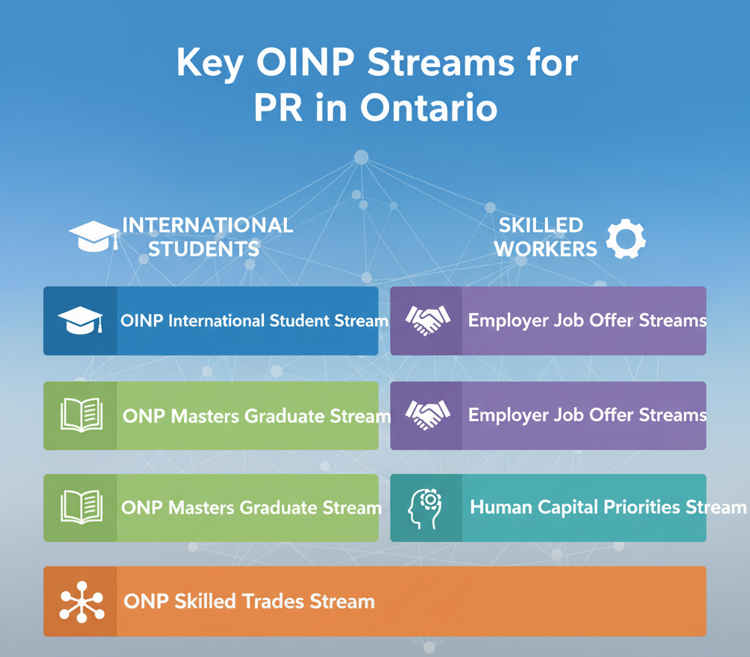
Ontario divides its immigration streams into two main categories:
1. Expression of Interest (EOI) Streams
These operate through an online ranking system. You submit an EOI profile with your qualifications, language ability, job details, etc. Ontario periodically invites top candidates to apply for a nomination.
Eligible EOI Streams Include:
-
Employer Job Offer: Foreign Worker
-
Employer Job Offer: International Student
-
Employer Job Offer: In-Demand Skills
-
Masters Graduate
-
PhD Graduate
2. Express Entry Linked Streams
For these streams, you must first have a valid Express Entry profile. Ontario reviews the Express Entry pool and sends Notifications of Interest (NOIs) to profiles that match their criteria.
Express Entry Streams:
-
Human Capital Priorities Stream
-
French-Speaking Skilled Worker Stream
-
Skilled Trades Stream
Once nominated through these streams, candidates get 600 extra CRS points in Express Entry, increasing their chances of receiving an Invitation to Apply (ITA) for PR.
OINP Expression of Interest (EOI) Streams
The EOI streams are best suited for applicants who do not yet have a nomination but meet Ontario’s labor market requirements. You do not submit a PR application yet — you submit an EOI. For OINP EOI streams, applicants usually need an eligible Ontario job offer and must meet stream-specific requirements for work experience, wage, education, language, and employer criteria.
1. Employer Job Offer: Foreign Worker Stream
This stream is for:
- Skilled workers with a full-time, long-term job offer from an Ontario employer
- Jobs must be in Career-oriented NOC TEER 0/1/2/3 occupations
Eligibility Highlights:
-
A permanent job offer in Ontario
-
Employer compliance with Ontario employment standards
-
Proof of qualifications for the job
2. Employer Job Offer: International Student Stream
For international students who:
- Completed a full-time degree/diploma in Ontario
- Receive a qualifying job offer
- Work permit status is valid at the time of application
This stream is extremely attractive to Ontario graduates as it bridges study → work → PR.
3. Employer Job Offer: In-Demand Skills Stream
This is for workers in specific in-demand occupations such as:
- Agriculture & Crop Research
- Construction
- Transport
- Manufacturing
- Logging and Fishing
Key points:
- A job offer from an Ontario employer is required.
- Work experience in the job category is expected.
- Language, education, and wage criteria vary by occupation.
4. Masters Graduate Stream
For applicants with a master’s degree from an eligible Ontario institution.
Applicants do not require a job offer — a key advantage for fresh graduates.
Eligibility Snapshot:
- Completed OG degree within 2 years
- Intend to live and work in Ontario
- Meet settlement funds requirements
5. PhD Graduate Stream
For doctoral graduates:
- Awarded a PhD from a publicly funded Ontario institution
- No job offer required
- Must be living in Ontario at the time of application
On June 26, 2026, Ontario replaced all eight of its former OINP streams with a single new stream — the Ontario Workforce Priority Stream — built around three distinct pathways. This is Phase 1 of a broader two-phase redesign of the province's immigration program.
6. TEER 0–3 Pathway
Aimed at skilled, internationally trained workers in management, professional, technical, and skilled trade occupations (NOC TEER 0, 1, 2, or 3). To qualify, candidates generally need:
- A full-time, permanent job offer from an eligible Ontario employer
- Minimum CLB 6 language ability (CLB 5 for some occupations)
- At least 6 months of work experience with the job-offer employer (reduced to 3 months for recent Ontario graduates)
This route can benefit foreign workers already employed in Ontario, international graduates with skilled job offers, and professionals looking for a PR path outside Express Entry's CRS competition.
7. TEER 4–5 Pathway
Opens the door to all TEER 4–5 occupations — a significant shift, since these roles previously fell under the more restrictive In-Demand Skills stream (limited to a short list of NOC codes). Minimum requirements:
- Full-time, permanent Ontario job offer
- 9 months of cumulative work experience in the last 2 years, in the job-offer position, with the job-offer employer
- CLB 4 in all four language abilities
- Canadian secondary school diploma or equivalent (an ECA is required for foreign credentials)
This benefits workers in food processing, hospitality, warehousing, personal support, transportation, and other frontline roles — provided the applicant is already working for the sponsoring employer, since foreign work experience alone doesn't qualify.
8. Self-Employed Physicians Pathway
The only pathway that doesn't require a traditional job offer. It's designed for physicians who work through independent or fee-for-service arrangements rather than employer-employee relationships. To qualify, a physician generally must:
- Be in good standing with the College of Physicians and Surgeons of Ontario (CPSO)
- Be eligible to bill through OHIP
This addresses a long-standing gap for internationally trained doctors practising — or preparing to practise — in Ontario.
The regulations are in force, but the Expression of Interest (EOI) system is currently closed and isn't expected to reopen until later in summer 2026. Anyone with an EOI under a former stream that hasn't received an invitation will have it automatically withdrawn — a new EOI will be required once the system reopens. Applicants who already received an invitation and submitted a full application continue to be assessed under the old rules.
Under the new OINP PR pathways, TEER 0–3 covers skilled roles, while TEER 4–5 supports eligible essential and frontline occupations.
How Ontario’s EOI Points System Works
Ontario uses an EOI system to rank candidates before issuing Invitations To Apply (ITAs). Although Ontario doesn’t publicly share the exact algorithm weights, the following key factors form the basis of scoring:
| Scoring Category | What It Reflects |
|---|---|
| Education | Level and relevance of education to job/stream |
| Job Offer Quality | Skill level, wage, NOC category |
| Work Experience | Length & relevance |
| Language Proficiency | CLB score in English/French |
| Wage | Higher wages often score better |
| Regional Factors | Jobs outside GTA may be prioritized |
| Paid Work in Ontario | Ontario work experience boosts score |
Your rank within the EOI pool determines whether Ontario invites you to apply.
Express Entry Linked Streams
These streams draw directly from the Express Entry pool, managed by IRCC.
1. Human Capital Priorities Stream
Targets candidates with:
- Strong language proficiency
- Skilled work experience
- A mid-to-high Comprehensive Ranking System (CRS) score in Express Entry
Ontario sends a Notification of Interest (NOI) to selected candidates, who then apply to OINP.
2. French-Speaking Skilled Worker Stream
For French-English bilingual candidates with strong profiles:
- Ability in both French and English
- Post-secondary education
- Skilled work experience
Emphasis is on enhancing Ontario’s Francophone workforce.
3. Skilled Trades Stream
For candidates with:
- Express Entry profile
- Work experience in skilled trades
- Canadian or international work experience in NOC TEER 2 or 3 trades
This stream focuses on occupations where tradespeople are in demand.
Official Ontario Draw Results And Invitations
Ontario regularly publishes official draw results for both EOI and Express Entry streams.
Example EOI Invitations (2024–2025)
| Stream | 2024 Invitations | 2025 Invitations |
|---|---|---|
| Foreign Worker | 6,695 | 4,860 |
| International Student | 8,363 | 6,605 |
| In-Demand Skills | 914 | 1,063 |
| Masters Graduate | 5,519 | 0 |
| PhD Graduate | 533 | 0 |
These numbers show how Ontario’s activity shifted from 2024 to 2025, especially in the graduate streams where Masters and PhD invitations were paused temporarily during updates.
Application Deadlines and Timelines
Once Ontario invites you to apply:
-
Masters/PhD Graduate stream: apply within 14 days of invitation
-
Employer Job Offer streams: employer submits their portion within 14 days, and the applicant has 17 days to submit
Failure to submit within deadlines means your EOI may not be processed.
Conclusion
Ensure your job offer (if required) meets wage and duration criteria
- Verify your language test results against CLB requirements
- Submit authentic documentation (education, work experience, job offer letters)
- Monitor Ontario’s official invitation pages regularly
- Apply quickly after receiving an invitation — missing deadlines cancels your opportunity