Recommended Blog Posts
- Manitoba MPNP Processing Time 2026: How Long Provincial Nomination and Canada PR Take
- MPNP Skilled Worker Stream 2026: Skilled Worker in Manitoba vs Skilled Worker Overseas
- MPNP Close Relative Points: How Family in Manitoba Boosts Your EOI Score (2026)
- Manitoba Latest PNP Draw – MPNP Results & Insights (2026)
Manitoba PNP 2026: Strategic Recruitment Initiatives for Healthcare and Food Processing Workers
Publish On: August 10, 2026
The Manitoba Provincial Nominee Program (MPNP) is taking an increasingly targeted approach to immigration in 2026. Instead of inviting every high-scoring Expression of Interest profile, many recent skilled-worker draws have focused on candidates who were directly connected to Manitoba through strategic recruitment initiatives, employer programs, regional communities and specific labour-market priorities.
Healthcare and food processing are particularly relevant because Manitoba continues to face workforce needs in these sectors, and both are currently listed as eligible sectors under the province's Temporary Resident Retention Pilot (TRRP).
However, there is an important distinction for applicants to understand: Manitoba is not simply searching Canada's federal Express Entry pool for healthcare and food-processing workers.
How Manitoba Strategic Recruitment Works in 2026
The MPNP uses an Expression of Interest, or EOI, system. Candidates submit profiles to Manitoba and may receive a Letter of Advice to Apply (LAA) when selected.
Throughout many 2026 draws, Manitoba has limited consideration under the Skilled Worker Stream to profiles that declared they had been directly invited by the MPNP through a strategic recruitment initiative, as well as certain candidates supported through the temporary public policy for prospective provincial nominees.
Strategic recruitment activity has included areas such as:
- Employer Services
- Francophone communities
- Regional communities
- Ethnocultural communities
Employer Services is especially important for foreign workers because Manitoba says its Strategic Initiative helps approved employers retain or recruit eligible workers and provides a streamlined route toward MPNP nomination.
For overseas workers, the Employer Direct Initiative (EDI) allows Manitoba employers that have exhausted reasonable local recruitment options to pursue qualified foreign workers where international recruitment will provide an economic benefit.
Does Manitoba Pick Candidates Directly From Express Entry?
Not exactly. Manitoba has its own MPNP EOI pool. Manitoba Latest draw notices specifically refer to candidates who submitted profiles under the Skilled Worker in Manitoba or Skilled Worker Overseas pathways and who had received a direct Manitoba invitation.
Some of these people also have active federal Express Entry profiles.
For example:
| 2026 MPNP Draw | Selection | LAAs | Express Entry-linked candidates |
|---|---|---|---|
| Feb. 12, Draw #264 | Strategic recruitment/TPP | 29 | 6 |
| Mar. 12, Draw #266 | Strategic recruitment/TPP | 46 | 5 |
| Apr. 9, Draw #268 | Strategic recruitment/TPP | 32 | 8 |
| June 4, Draw #272 | Strategic recruitment/TPP | 104 | 15 |
The figures show that only part of each selected group necessarily had a valid Express Entry profile number and job seeker validation code.
Manitoba selects candidates through the MPNP and may issue enhanced provincial nominations to candidates who are also eligible under Express Entry.
An Express Entry candidate who accepts a provincial nomination receives 600 additional CRS points, significantly strengthening the likelihood of receiving a federal Invitation to Apply for permanent residence.
Manitoba's 2026 PNP Allocation
IRCC allocates Manitoba a specific number of provincial nominations each year.
For 2026, Manitoba received 6,239 MPNP nomination spaces. Manitoba's official monthly statistics showed 1,745 nominations issued from January through April 2026. Of these, 571 were classified as enhanced nominations connected with Express Entry.
| Period | Total MPNP nominations | Enhanced nominations |
|---|---|---|
| January 2026 | 484 | 154 |
| February 2026 | 425 | 146 |
| March 2026 | 390 | 129 |
| April 2026 | 446 | 142 |
| Jan.–Apr. total | 1,745 | 571 |
This demonstrates why applicants should not assume that every Manitoba nomination operates through Express Entry. Manitoba can issue both base nominations through the non-Express Entry process and enhanced nominations connected to Express Entry.
Why Healthcare Is Important for Manitoba PNP in 2026
Healthcare has received clear attention in Manitoba's immigration and labour-market planning.
On April 23, 2026, MPNP Draw #269 conducted an occupation-specific selection for people currently employed in Manitoba in NOC broad occupational category 3 — Health occupations.
The province issued 192 LAAs through that healthcare-focused selection. A separate portion of the same draw issued another 116 LAAs to candidates connected to strategic recruitment initiatives and the temporary public policy.
That distinction is important: the 192 healthcare invitations were an occupation-specific Skilled Worker in Manitoba selection, not simply an Express Entry healthcare draw.
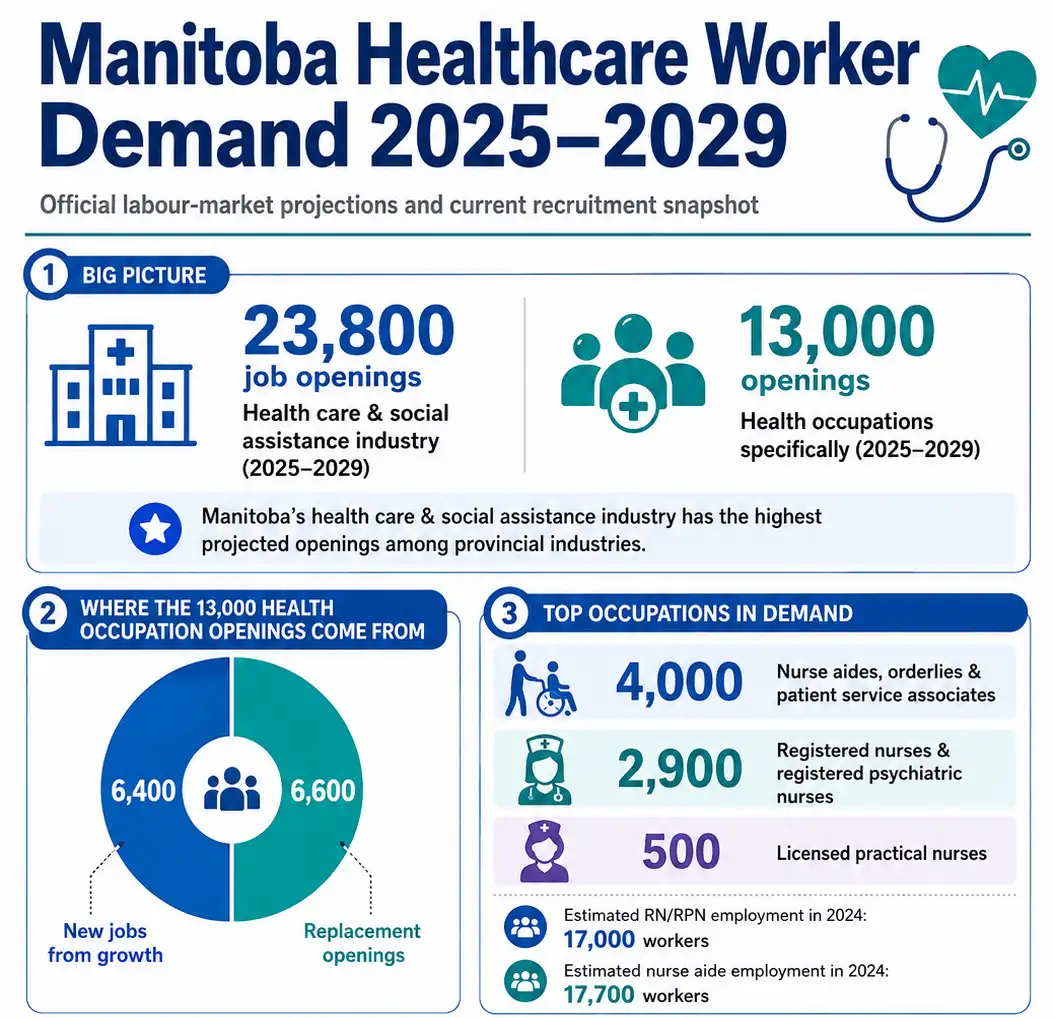
Manitoba's labour-market data supports the focus on healthcare. The province projects approximately 23,800 job openings in health care and social assistance between 2025 and 2029, the highest number among Manitoba industry groups.
Several healthcare occupations also appear among Manitoba's highest-opportunity occupations. For example:
| Occupation | NOC | Projected openings 2025–2029 |
|---|---|---|
| Nurse aides, orderlies and patient service associates | Various relevant NOCs | 4,000 |
| Registered nurses and registered psychiatric nurses | 31301 | 2,900 |
Manitoba's labour outlook therefore provides an economic explanation for why healthcare workers continue to appear in targeted immigration and workforce initiatives.
Food Processing Workers: Do They Have a Manitoba PR Opportunity?
Yes, but applicants need to understand the difference between food processing and hospitality sectors.
Food processing remains an eligible sector under Manitoba's Temporary Resident Retention Pilot. Current eligible sectors include:
| Eligible TRRP sectors |
|---|
| Agriculture |
| Construction and trades |
| Information technology |
| Food processing |
| Healthcare |
| Education |
| Manufacturing |
| Certain approved skilled trades |
By contrast, hospitality and food services was removed from TRRP eligibility effective February 4, 2026.
This means employment in a food-manufacturing or processing business should not automatically be confused with restaurant, accommodation or food-service employment.
Food processing is economically significant in Manitoba. Provincial statistics report that food and beverage processing represented approximately 35% of Manitoba manufacturing sales in 2025. Food manufacturing sales reached approximately $9.5 billion in 2025, and the sector directly employed 16,365 people in 2024.
How the Temporary Resident Retention Pilot Works
TRRP is primarily designed for Manitoba employers that want to retain temporary foreign workers who are already working for them.
A candidate generally needs to:
- Currently live in Manitoba.
- Have worked full-time for the same employer for at least 18 months.
- Work at least 30 hours per week.
- Have a long-term, permanent job offer.
- Have spent more than 50% of their total time in Canada residing in Manitoba.
- Generally be between 21 and 45, unless otherwise specified by the employer.
- Have a valid work permit expiring in less than one year or be on maintained status.
- Meet at least CLB 5 for TEER 0–3 employment or CLB 4 for TEER 4–5 employment.
- Meet the MPNP's minimum 60-point assessment threshold.
For regulated healthcare occupations, applicants must also address provincial licensing or registration requirements. Immigration eligibility itself does not give someone permission to practise a regulated health profession.
Healthcare or Food Processing Workers Outside Canada?
For workers abroad, the more relevant employer-based option may be Manitoba's Employer Direct Initiative.
The program is primarily designed to help qualifying Manitoba employers recruit from overseas after local recruitment options have been exhausted.
Candidate requirements generally include:
| Factor | Employer Direct Initiative requirement |
|---|---|
| Age | Normally 21–45 |
| Relevant experience | At least 2 years in previous 5 years |
| TEER 0–3 language | Minimum CLB/NCLC 5 |
| TEER 4–5 language | Minimum CLB/NCLC 4 |
| Education | Relevant post-secondary education/training, subject to certain TEER exceptions |
| Job | Long-term, full-time employment |
| MPNP assessment | Minimum 60 points |
Candidates also need to demonstrate a genuine ability and intention to settle in Manitoba.
This is not a general job-matching program. Manitoba specifically tells foreign workers not to send resumes directly to Employer Services. Workers looking for jobs should search legitimate employment sources such as the Work in Manitoba portal and the federal Job Bank and apply to employers that are actively recruiting.
Strategic Recruitment and the Skilled Worker Overseas Pathway
A direct invitation from MPNP through a Strategic Recruitment Initiative is also recognized as a qualifying Manitoba connection under the Skilled Worker Overseas pathway.
Under the SWO eligibility framework, applicants need an established Manitoba connection through:
- Manitoba family or community support,
- previous Manitoba employment or education, or
- an MPNP Strategic Recruitment Initiative invitation.
Candidates must also score at least 60 points under the program's assessment system. A Strategic Recruitment Initiative invitation provides 20 adaptability points under that assessment grid.
Simply having an Express Entry profile, healthcare occupation or food-processing occupation does not by itself create this Manitoba connection.
From Manitoba Selection to Canada PR
The practical process generally looks like this:
- Establish MPNP eligibility or employer support: This could come through Manitoba employment, an approved employer initiative, a Strategic Recruitment Initiative or another qualifying Manitoba connection.
- Create an MPNP Expression of Interest.
- Receive a Letter of Advice to Apply.
- Submit the complete MPNP nomination application.
- Receive provincial nomination if approved.
- Apply separately to IRCC for permanent residence.
Manitoba confirms that after nomination, applicants are responsible for submitting their PR application to the federal government. For Manitoba nominees following the provincial process, the PR application must generally be made within 180 days of nomination.
For Express Entry-linked nominees, accepting the provincial nomination results in the additional 600 CRS points used in the federal Express Entry system.
Final Takeaway
The Manitoba PNP in 2026 is becoming increasingly targeted, but applicants should avoid interpreting that as Manitoba simply searching the federal Express Entry pool for healthcare and food-processing workers.
Manitoba's actual system combines its own EOI process, strategic recruitment initiatives, employer-led recruitment and retention programs, occupation-specific selections and both base and Express Entry-enhanced nominations.
Healthcare workers have particularly strong evidence of provincial demand: Manitoba issued 192 healthcare-focused LAAs on April 23, 2026, while the province forecasts 23,800 job openings in health care and social assistance between 2025 and 2029.