Recommended Blog Posts
Quebec Immigration Targets 2026 – Updated Rules, In-Demand Jobs, and PR Options for Temporary Residents
Publish On: November 15, 2025
As 2026 approaches, Quebec is reshaping its immigration vision to match its labour needs and demographic priorities. The province — known for its cultural distinctiveness and strong control over immigration policy — is taking a more targeted, talent-driven approach.
The PSTQ is a points-based immigration program run by the Government of Quebec to select foreign nationals whose skills, education, language ability, and work experience match Quebec’s labour market needs.
Selected candidates receive a Quebec Selection Certificate (CSQ), which allows them to apply for Canadian PR with IRCC.
A Turning Point for Quebec’s Immigration Goals
For newcomers, temporary residents, and skilled workers already in Quebec, this year marks a significant opportunity. Not only are immigration targets increasing, but the rules around language, selection, and employer sponsorship are also evolving to make pathways to permanent residence (PR) clearer and faster.
Let’s explore what Quebec’s 2026 immigration plan means — from admission targets and in-demand jobs to new policies, PR routes, and expert tips for success.
Quebec’s 2026 Immigration Vision and Updated Targets
Quebec’s immigration direction for 2026 focuses on one main goal: sustain economic growth while preserving the province’s French identity.
According to early projections, Quebec plans to welcome between 55,000 and 58,000 new permanent residents in 2026, rising from 52,500 in 2025. The increase reflects ongoing efforts to counter labour shortages — particularly in healthcare, IT, and skilled trades — while reinforcing French-language integration.
Breakdown of 2026 Admissions
| Category | Approx. Target (2026) | Purpose |
|---|---|---|
| Economic Immigration (Skilled Workers, Business, PNP equivalents) | 33,000–35,000 | Filling labour gaps & regional growth |
| Family Sponsorship | 10,000–11,000 | Reuniting families within Quebec |
| Refugees & Humanitarian | 6,000–7,000 | Humanitarian commitments |
| Francophone Integration & Other Programs | 5,000 | Supporting language and settlement |
Unlike other provinces, Quebec independently manages its immigration system under the Canada–Quebec Accord. The province selects its own skilled workers through QSWP and PEQ, issuing the CSQ before federal approval from IRCC.
Top Occupations in High Demand in Quebec for 2026
MIFI identifies job shortages annually. For 2026, demand is highest in these sectors:
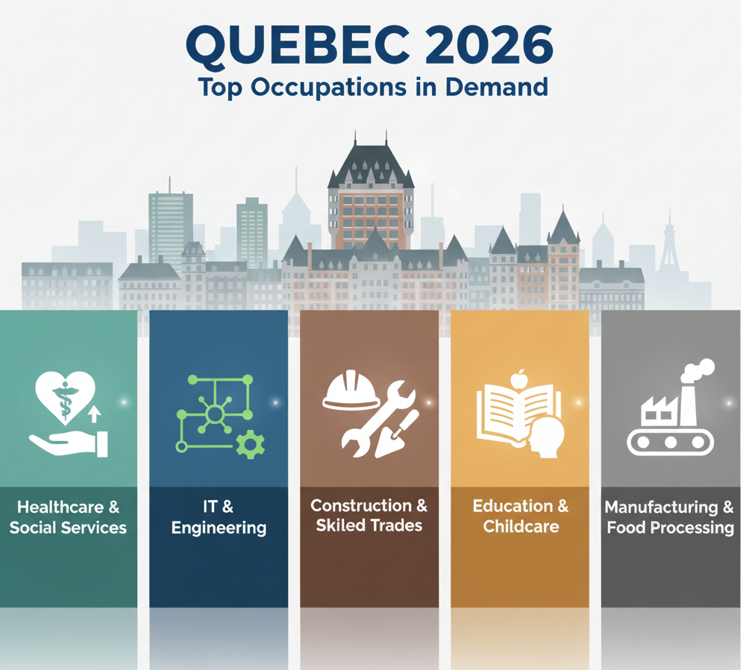
1. Healthcare and Social Services
- NOC 31102 – General Practitioners and Family Physicians
- NOC 31301 – Registered Nurses and Psychiatric Nurses
Healthcare staffing shortages continue, especially outside Montreal. Bilingual nurses and internationally trained workers remain key recruitment targets.
2. IT and Engineering
- NOC 21231 – Software Engineers and Designers
- NOC 21300 – Civil Engineers
Tech firms and infrastructure projects in Montreal and Quebec City are expanding, with strong demand for French-speaking professionals.
3. Construction and Skilled Trades
- NOC 72300 – Plumbers
- NOC 72400 – Electricians
4. Education and Childcare
- NOC 42202 – Early Childhood Educators
5. Manufacturing and Food Processing
- NOC 75110 – Industrial Butchers and Meat Cutters
New Immigration Rules and Policy Changes in 2026
Quebec’s 2026 update features several policy advancements:
1. Revised French Proficiency Standards
Higher French-speaking and comprehension requirements for PEQ and QSWP, especially for public-facing roles.
2. Updated Employer-Sponsored Work Permit Rules
Certain pilot schemes allow employers to hire foreign workers with reduced LMIA requirements, supporting faster PR transitions.
3. Integration of AI-Based Screening
AI-assisted triage will accelerate CSQ and PR processing for complete and error-free applications.
4. Expansion of Francophone Settlement Programs
More online and in-person French learning tools for newcomers.
Increase in Invitations Compared to 2025
Admissions are expected to rise from 52,500 in 2025 to 55,000–58,000 in 2026.
The Arrima portal may issue 5–10% more invitations, prioritizing French speakers, job-offer holders, and Quebec graduates/workers.
Permanent Residency Options in 2026 for Temporary Residents
1. Quebec Experience Program (PEQ)
- 12 months of skilled Quebec work experience
- OR a Quebec educational credential
Requires strong French skills.
2. Quebec Regular Skilled Worker Program (QSWP)
Points-based selection through the Arrima system. Candidates apply for the CSQ, followed by federal PR processing.
3. Employer-Driven LMIA or Arrima Invitations
Workers with employer sponsorship or Arrima ITAs can transition to PR once eligible.
Quebec Immigration 2026: Step-by-Step Application Process
- Create an Arrima profile and submit an EOI.
- Receive an Invitation to Apply (ITA) from MIFI.
- Submit the CSQ application.
- After CSQ approval, apply for federal PR.
- Receive COPR and complete your landing.
Financial Requirements & Processing Time
rocessing times (approx):
- PEQ: 8–12 months
- QSWP: 12–18 months
Consultant’s Insight: Strategic Tips for Quebec PR Applicants in 2026
- Prioritize French — Language is the strongest factor in Quebec immigration.
- Gain Quebec experience — Study or work experience boosts Arrima ranking.
- Do not use Express Entry — Quebec has its own PR selection process.
- Apply early — Catch upcoming Arrima draws.
- Maintain legal status — Keep your permits valid throughout the process.
Seeking expert guidance is recommended for applicants with complex profiles or multiple job roles.
Conclusion: Building Your Future in Quebec
Quebec’s 2026 immigration plan signals strong opportunities for newcomers willing to contribute to its economy and embrace its French-speaking identity. With increased invitations, employer flexibility, and modernized processing, 2026 is one of the most promising years to secure permanent residence in Quebec.