Recommended Blog Posts
- The Ultimate 2026 Guide: Canada Immigration From Nigeria
- Nursing Officer Salary in Canada in 2026: Is Moving to Canada Still Worth It for International Nurses?
- How Young Professionals Can Work in Canada Through IEC
- The Ultimate 2026 Guide: Canada Immigration From the UK
- Eligibility for Canada Pension Plan (CPP) and Old Age Security (OAS)
Spousal Sponsorship Canada 2026 – New Rules, Processing Time & How to Apply
Publish On: November 19, 2025
Bringing your spouse to Canada is one of the most rewarding experiences—but the application process can be complex if you don’t know the latest rules. In 2026, Spousal Sponsorship remains Canada’s main PR pathway for couples, but approvals depend on sponsor eligibility, a genuine relationship, and a complete, well-evidenced application. Processing times are not fixed—IRCC updates them regularly via its official tool—so your best strategy is to apply with strong proof upfront and respond quickly to biometrics/medical requests.
What is Spousal Sponsorship in Canada?
The Spousal Sponsorship Program allows Canadian citizens and permanent residents to sponsor their spouse or common-law partner for permanent residency. This pathway helps families reunite and live together in Canada permanently.
Canada’s new 2026–2028 Immigration Levels Plan keeps Spousal Sponsorship strong and stable, with the Family Class receiving about 81,000–84,000 PR admissions each year. While Canada is reducing temporary resident numbers and increasing economic-class immigration, family reunification remains protected, meaning spouses and partners can continue to apply with confidence. The targets show no cuts to spousal sponsorship, and processing is expected to remain consistent, making it one of the most reliable pathways for PR under the new plan.
New Spousal Sponsorship Rules for 2025–26
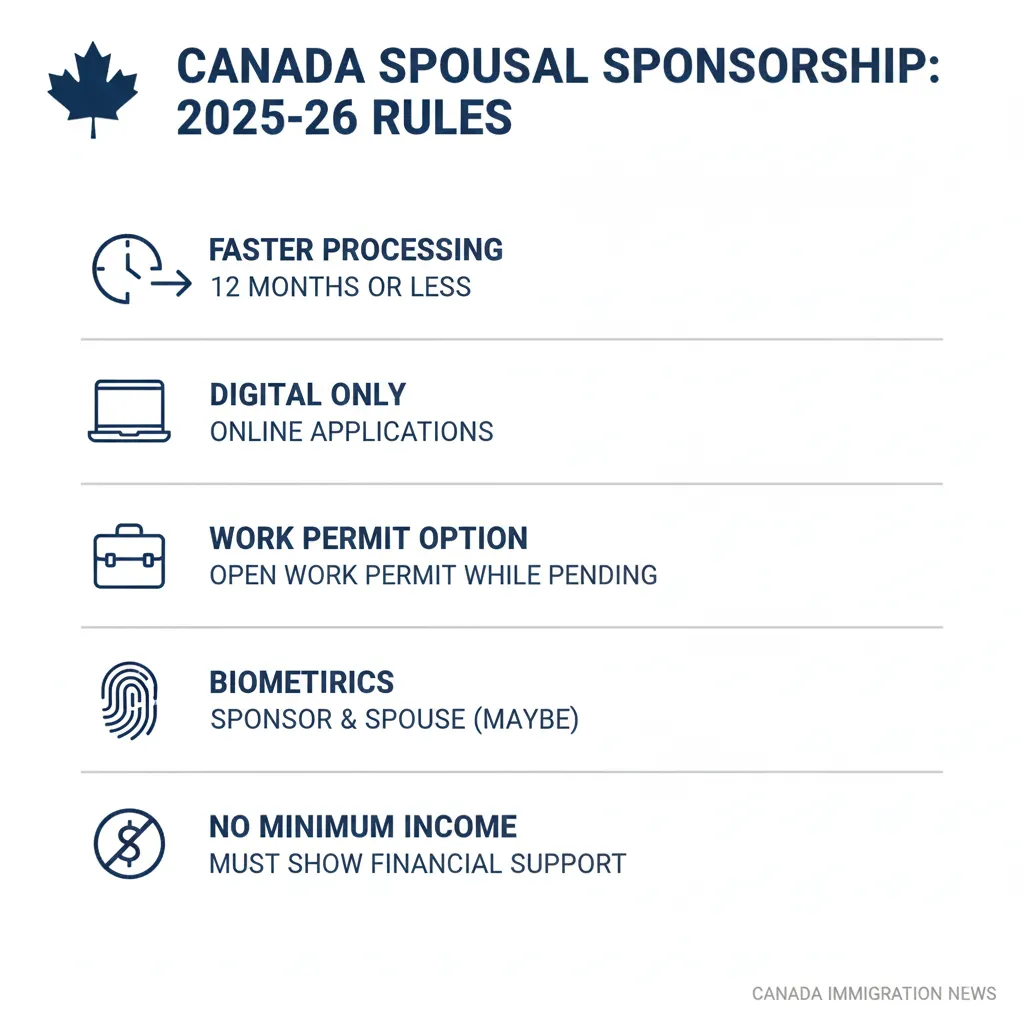
The Canadian government updates immigration policies regularly, and 2025 is no exception. Here are the key changes to note:
- Faster Processing Initiatives: IRCC aims to reduce processing times for spousal sponsorship applications to 12 months or less.
- Digital Applications Only: Paper-based applications are no longer accepted; applicants must use the IRCC online portal.
- Open Work Permit Option: Sponsored spouses can apply for an open work permit while their PR application is in process.
- Biometric Requirements: Both the sponsor and the spouse may need to provide biometrics, depending on the situation.
- Income Requirements: No minimum income requirement for spousal sponsorship (unlike parent sponsorship), but sponsors must prove financial ability to support their spouse.
Who Can Apply for Spousal Sponsorship?
You can sponsor your spouse if you:
- Are 18 years or older
- Are a Canadian citizen or permanent resident
- Are not receiving social assistance (except for disability)
- Can provide financial support for your spouse for 3 years
Spousal Sponsorship Processing Time in 2025–26
IRCC’s standard processing time for spousal sponsorship applications is:
- Inland Applications: 12 months
- Outland Applications: 12–18 months (depending on the country)
Pro Tip: Submit a complete application with all supporting documents to avoid delays or refusal . Incomplete applications are the most common reason for processing delays.
Required Documents for Spousal Sponsorship
Here’s a checklist of documents you’ll need for 2025–26.
For the Sponsor:
- Proof of Canadian citizenship or PR (passport, PR card)
- Proof of income (recent Notice of Assessment, job letter)
- Marriage certificate or proof of relationship
- Police clearance certificate (if required)
For the Spouse (Applicant):
- Valid passport
- Medical exam confirmation
- Police clearance certificate from every country lived in for 6+ months
- Photos meeting IRCC specifications
Relationship Proof:
- Joint bank accounts, bills, lease agreements
- Photos together
- Chat history and communication evidence
How to Apply for Spousal Sponsorship in Canada (Step-by-Step)
- Check Your Eligibility – Both sponsor and spouse must meet IRCC requirements.
- Create an Online Account on the IRCC Portal – Complete the spousal sponsorship application package.
- Gather All Documents – Include every required document and proof of relationship.
- Pay Application Fees Online – Sponsorship fee, biometrics fee, and permanent residence processing fee.
- Submit Application Online – Upload documents and forms.
- Provide Biometrics and Medical Exam – As per IRCC instructions.
- Wait for Processing & Updates – Respond to IRCC requests promptly.
Common Reasons for Spousal Sponsorship Refusals
- Missing documents or incomplete forms
- Weak relationship proof
- Incorrect forms or outdated versions
- Not responding to IRCC within deadlines
Avoid these issues by working with a licensed RCIC who ensures your application is 100% complete and accurate.
Final Thoughts
Spousal Sponsorship Canada 2026 allows Canadian citizens and permanent residents to sponsor their spouse or common-law partner for permanent residence, provided the relationship is genuine and all eligibility requirements are met. IRCC continues to assess applications based on relationship authenticity, sponsor eligibility, and completeness of documents, while processing times are updated regularly through the official IRCC tool. Submitting accurate forms, strong relationship evidence, and responding promptly to biometrics and medical requests remains the key to faster and successful approval.