Recommended Blog Posts
- How to Immigrate to Canada from the USA in 2026
- Canada Super Visa vs. PGP: Which Path is Faster for Parent Reunification?
- What Are the Best Immigration Pathways for Nurses in Canada in 2026?
- Orthopedic Surgeon Salary In Canada By Province: What Experienced Surgeons Can Expect In 2026
- Practical Tips for a Successful PRTD Application | 2026
Super Visa Income Requirements 2025-26 | Updated LICO Table & Eligibility Guide
Publish On: November 28, 2025
Planning to bring your parents or grandparents to Canada? The Super Visa program is one of the best options for long-term family visits. However, meeting the income requirement is the most critical part of getting approval. If your financial eligibility doesn’t meet the government’s Low-Income Cut-Off (LICO), your application may face a refusal.
What Is the Super Visa & Why Income Matters?
LICO (Low Income Cut-Off) is a yearly-published income threshold by Statistics Canada that shows the minimum income below which a family typically spends a larger share on necessities. It is used by IRCC to determine the Minimum Necessary Income (MNI) for certain immigration programs — including the Super Visa.
For the Super Visa, the host (the child or grandchild in Canada) must meet or exceed the MNI based on family size to prove they can financially support visiting parents or grandparents during their stay.
Updated Super Visa LICO Table for 2025–26
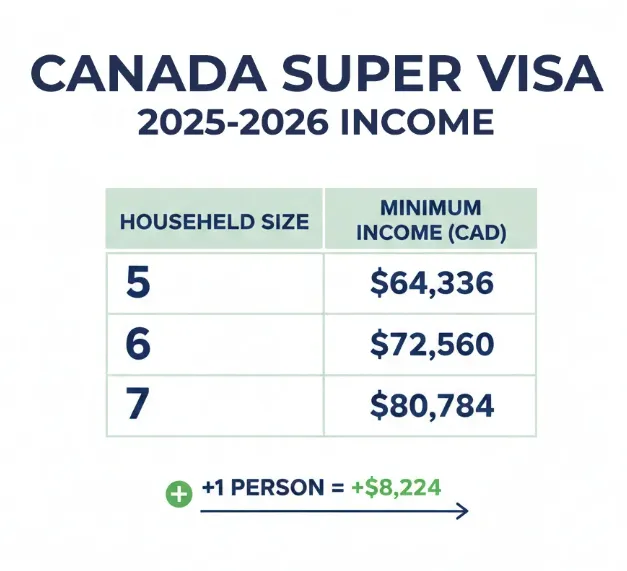
Below is the minimum income requirement based on family size (including the sponsor, spouse, dependents, and the parents or grandparents being invited):
| Family Size | Minimum Necessary Income (CAD) |
|---|---|
| 1 person | $28,500 |
| 2 persons | $35,000 |
| 3 persons | $43,000 |
| 4 persons | $52,000 |
| 5 persons | $59,000 |
| 6 persons | $66,000 |
| 7 persons | $73,000 |
| Each additional person | + $7,000 |
(These figures are estimates based on annual adjustment trends. Always confirm the latest table on IRCC’s official website before applying.)
How to Calculate Your Family Size for LICO
Family size includes:
- You (the sponsor)
- Your spouse or common-law partner
- Your dependent children
- Your parents or grandparents coming on Super Visa
- Any dependents of your parents or grandparents
Example: If you are married, have two children, and want to invite both parents, your family size is 6 members, so the required income is approximately $66,000.
How to Meet the Income Requirement
To show financial eligibility, the host should submit proof of income, such as:
- Recent Canada Revenue Agency (CRA) Notices of Assessment (NOA)
- T4 and/or T1 tax forms
- Pay stubs or an employer letter
- Bank statements or employment insurance records
These documents help prove the host’s income meets or exceeds the required LICO threshold.
Common Mistakes That Lead to Super Visa Refusals
Even if you meet the income requirement, many applications are refused due to avoidable errors:
- Incorrect calculation of family size
- Not including all income sources (bonuses, rental income, business income)
- Submitting outdated NOAs
- Missing employer verification letters
- Weak proof of ongoing employment
- Insufficient funds shown for travel or insurance
Documentation Checklist to Prove Income Eligibility
You should submit clear and verifiable documents, including:
- Latest CRA Notice of Assessment (NOA)
- T4 or T1 tax slips
- Employment letter stating salary and job status
- Pay stubs from the last three months
- Bank statements for economic stability
- Proof of additional income (rental, investments, etc.)
Tip: Submitting strong supporting documents reduces the risk of delays or refusal.
Other Key Super Visa Requirements for 2025
- Valid medical insurance from a Canadian insurer (minimum $100,000 coverage)
- A written invitation letter from the sponsor
- Proof of parent–grandparent relationship
- Medical examination for parents or grandparents
Expert RCIC Tips to Secure Approval
Double-check family size before applying. Combine all income sources. Avoid gaps in employment proof. Purchase the correct insurance policy. Submit a complete application the first time to prevent refusals or delays.