Recommended Blog Posts
- What Is Bill C-12 and How It Impacts Your Canada Study Visa Application
- Australia Border Opening for International Students: Latest Updates 2026
- Top Mistakes Students Make When Applying For a Canada Study Permit in 2026
- Beyond the LOA: Why K7 Immigration's SOP Strategy is Key to Your Study Visa Approval
- Study Agriculture and Crop Research in Canada: Admission Process, Eligibility, and Scholarships for International Students
What Are the PGWP Updates for 2026 and How Do They Affect Your Application?
Publish On: December 15, 2025
For many international students, the PGWP is more than a work permit; it's a bridge to Canada's job market, a pathway to Permanent Residency, and a way of gaining the Canadian experience that IRCC values so highly.
PGWP rules have changed a lot between 2024 and 2026.
From new program-based eligibility rules to limits on private colleges, revised study permit conditions, and updated processing expectations—students need clarity more than ever.
The Post-Graduation Work Permit (PGWP) is an open work permit that lets international students work for any employer, in any location in Canada, after finishing an eligible program at an eligible institution.
In simple terms:
- Canada allows you to stay and work after you graduate
- You do NOT need a job offer to apply
- You can work full-time
- You can switch employers
- You can gain the Canadian work experience needed for PR
The PGWP is one of the most flexible post-study work programs in the world, which is why thousands of students choose Canada every year.
New Changes to PGWP in 2025–2026
The PGWP in 2026 is NOT what it used to be. Here are the biggest updates affecting students applied for Canadian Study Permit:
1. Many Private College Programs Are No Longer PGWP-Eligible
Starting January 2024 and reinforced in 2025–2026, IRCC ended PGWP access for:
- Public–private partnership colleges
- Most private career colleges
- Any newly created private DLI programs
Students enrolling in these may not get a PGWP—even if previous batches did.
2. PGWP Length Now Stricter Based on Program Duration
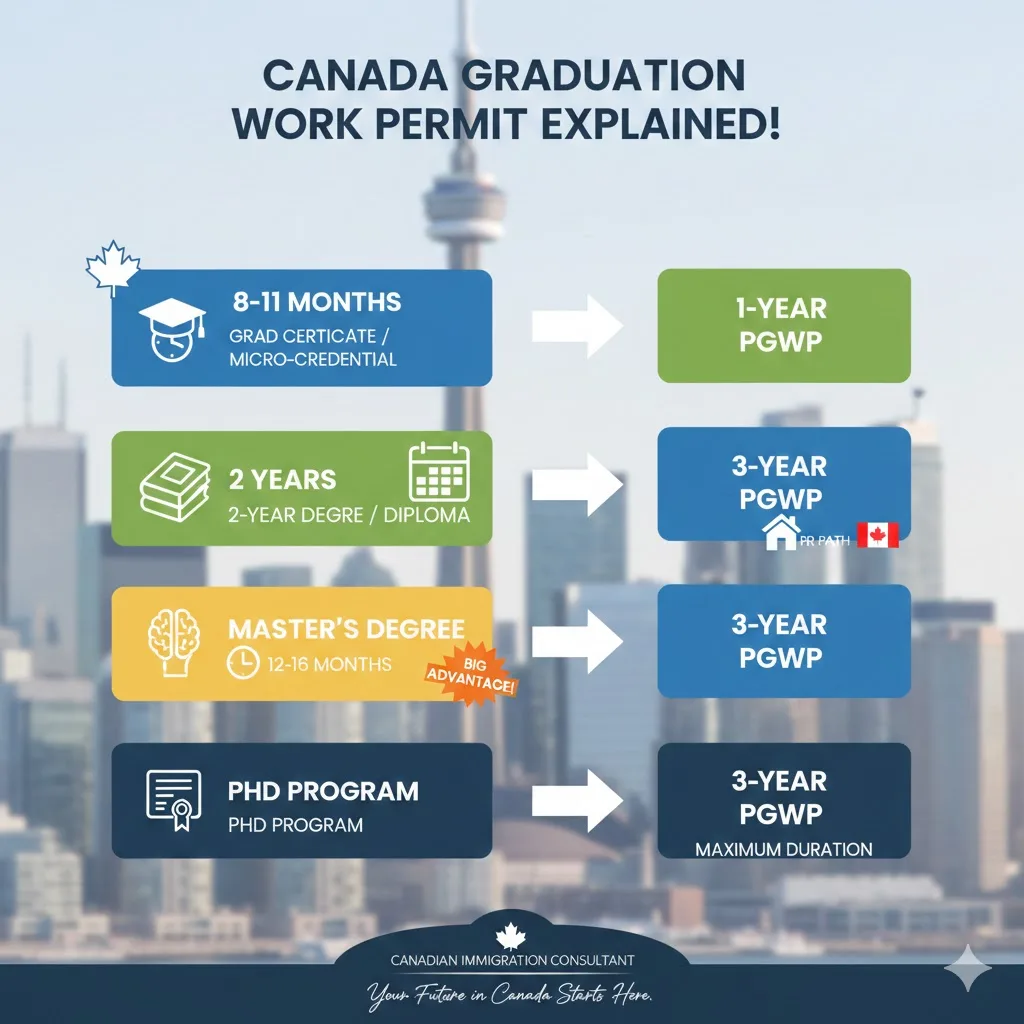
IRCC is enforcing exact PGWP durations:
- 8 months – 1 year program → Up to 1-year PGWP
- 2-year program → 3-year PGWP
- 3+ year program → 3-year PGWP (maximum)
- Master's program (even <2 years) → 3-year PGWP
3. Updated Rules for Students Who Change Schools or Programs
Students who:
- changed Designated Learning Institutions DLIs,
- transfer from private to public colleges, or
- switch to non-eligible programs
must report changes to IRCC or risk losing PGWP eligibility.
4. Online/remote study rules are fully back to normal
Online learning outside Canada no longer counts toward PGWP eligibility.
5. Co-op, internships, or breaks must follow strict rules
Unauthorized breaks or unapproved co-op work can impact PGWP approval.
PGWP Eligibility by Program Type (DLI, Public Colleges, Universities, Private Institutions)
To avoid confusion, here is a simple breakdown:
| 1. Public Colleges | Fully PGWP-eligible Most trusted option for diploma & advanced diploma students 1–3 years programs → PGWP as per duration |
| 2. Public Universities | Always PGWP-eligible Best for bachelor's, master's, and PhD students Master's programs under 2 years → still qualify for 3-year PGWP |
| 3. Private Universities (Recognized) | Some are PGWP-eligible, but not all Programs must be degree-granting (BA, BSc, MA, MBA, etc.) |
| 4. Private Colleges (Career Colleges & PPP Colleges) |
Mostly NOT PGWP-eligible after 2024 are degree-granting, and |
| 5. DLIs Offering Pathway Programs |
ESL, foundation programs, and some certificate courses do not qualify. You must complete a PGWP-eligible main program. |
PGWP Duration Explained: How Long You Can Work After Graduation
IRCC issues PGWPs based on the length of your program:
Final Thoughts: Making the Most of Your PGWP Journey in Canada
Your PGWP can be the turning point in your Canadian journey. Despite strict IRCC scrutiny, Kaira Martin's PGWP extension was approved through a precise, error-free application and timely submission. Whether your goal is work experience, income, or Permanent Residency, planning your studies and career with PGWP rules in mind is essential in 2025–2026.
Here's the simplest advice:
- Choose a PGWP-eligible, reputable institution
- Pick a program with long-term employment potential
- Maintain your full-time student status
- Apply for your PGWP on time
- Start planning for PR early
A PGWP doesn't just give you permission to work—it gives you the time, flexibility, and opportunity to build the future you want in Canada.