Recommended Blog Posts
- Top Designated Learning Institutions (DLIs) in 2026: Province-Wise Guide for International Students
- M College Canada Closure Explained: Programs, Fees, and Student Impact
- Why Study Visa Applications Get Refused and What You Can Do to Avoid Rejection
- Beyond the Visa: Your 2026 Canada Study Success Blueprint
- What Are the PGWP Updates for 2026 and How Do They Affect Your Application?
Top Mistakes Students Make When Applying For a Canada Study Permit in 2026
Publish On: April 18, 2026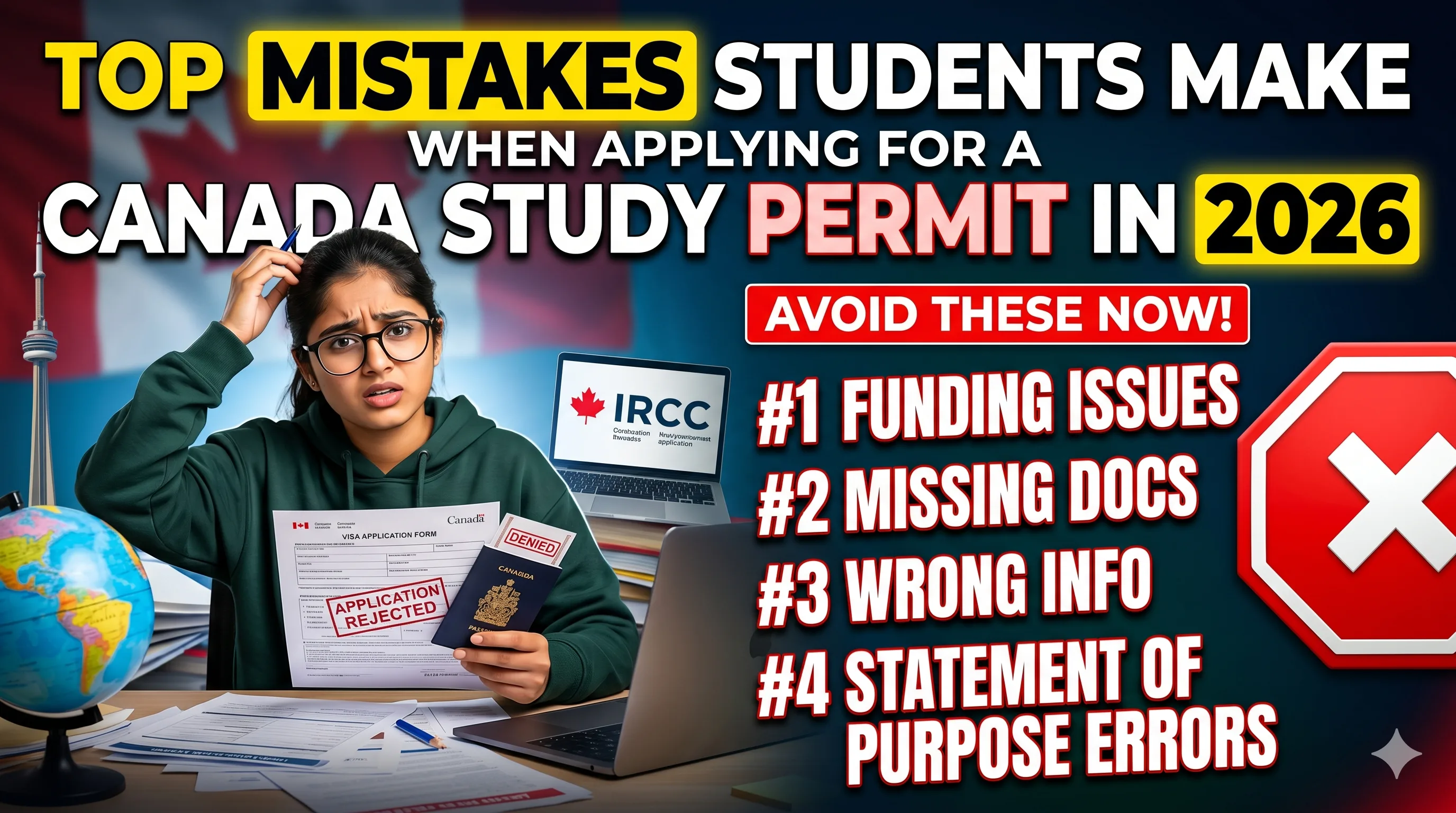
Canada continues to be one of the most preferred destinations for international students due to its high-quality education, post-study work opportunities, and clear immigration pathways. However, a large number of study permit applications are refused every year due to avoidable mistakes.
Understanding these mistakes is critical if you want to improve your approval chances. Immigration, Refugees and Citizenship Canada (IRCC) evaluates applications based on documentation accuracy, intent, and financial capability.
What Is a Canada Study Permit?
A Canada Study Permit is an official document issued by IRCC that allows foreign nationals to study at designated learning institutions (DLIs) in Canada. It is not a visa but a permit that authorizes your stay for educational purposes.
Applicants must demonstrate financial stability, genuine intent to study, and compliance with immigration rules.
Why Study Permit Applications Get Refused
Study permit refusals often occur due to weak documentation, unclear study plans, or doubts about the applicant’s intent to return to their home country. Even minor errors can raise red flags.
Below is a breakdown of the most common refusal factors:
| Refusal Reason | Impact |
|---|---|
| Insufficient Funds | High |
| Weak SOP | High |
| Unclear Career Path | Medium |
| Incomplete Documents | High |
| Ties to Home Country | High |
Top Mistakes Students Make When Applying For a Canada Study Permit
1. Writing a Weak Statement of Purpose (SOP)
The SOP is one of the most critical documents in your application. Many students submit generic or copied SOPs that fail to explain their study goals clearly.
A strong SOP should explain why you chose the course, how it aligns with your background, and how it supports your future career plans.
2. Showing Insufficient or Improper Proof of Funds
Applicants must show they can cover tuition fees and living expenses. As per IRCC, students must demonstrate at least CAD 20,635 per year (outside Quebec) for living costs.
Using unverifiable funds or last-minute deposits often leads to rejection.
3. Choosing an Irrelevant Course
Selecting a course that does not align with your previous education or work experience raises concerns about your genuine intent.
Visa officers expect logical academic progression, not random course selection.
4. Submitting Incomplete or Incorrect Documents
Missing documents such as transcripts, IELTS scores, or offer letters can result in immediate refusal. Even small inconsistencies can create doubts.
Always cross-check your application before submission.
5. Ignoring Proof of Ties to Home Country
Applicants must demonstrate strong ties to their home country, such as family, property, or job prospects.
Failure to prove this can make the visa officer believe you may not return after your studies.
6. Unexplained Gaps in Education or Work History
Study or work gaps without proper explanation can lead to suspicion. Always justify gaps with valid reasons such as work experience, training, or personal circumstances.
7. Overlooking Medical and Background Requirements
Failure to complete medical exams or provide police clearance certificates can delay or reject your application.
8. Applying Too Late
Late applications can result in missing intake deadlines or insufficient time for visa processing.
Apply at least 3–6 months before your course start date.
Latest Canada Study Permit Statistics (2025–2026)
Recent trends show that Canada continues to manage study permit volumes more strictly while prioritizing genuine students.
| Year | Applications Received | Approval Rate |
|---|---|---|
| 2024 | ~1.1 Million | 60% |
| 2025 | ~1.05 Million | 58% |
| 2026 (Expected) | ~1 Million | Selective |
How To Avoid These Mistakes
Following a structured approach can significantly improve your chances of approval.
- Write a personalized and clear SOP
- Provide genuine and verifiable financial proof
- Choose courses aligned with your background
- Submit complete documentation
- Show strong home country ties
- Apply early
Expert Tips For 2026 Applicants
With stricter policies and increasing competition, students must focus on authenticity and clarity.
Visa officers are now more focused on identifying genuine students rather than processing high volumes.
- Avoid agents who promise guaranteed visas
- Use official IRCC guidelines only
- Ensure consistency across all documents
- Highlight career progression clearly
Conclusion
Applying for a Canada Study Permit in 2026 requires careful planning, accurate documentation, and a clear understanding of immigration expectations. Most refusals happen due to avoidable mistakes that can be corrected with proper preparation.
By focusing on authenticity, financial clarity, and a strong study plan, students can significantly improve their chances of approval and successfully begin their academic journey in Canada.