Recommended Blog Posts
- How Your CLB Score Directly Affects Your CRS Score
- Can You Get Canada PR as a Construction Manager Without a Canadian Job Offer?
- IRCC Application Status Explained: AOR, Medical Passed, PPR, COPR
- Global Talent Stream to CEC: How Canadian Work Experience Can Support PR
- 7 Important Steps Before Applying For Canada’s Parents Sponsorship Program (PGP)
IEHP Programs in Canada: Helping Foreign Doctors & Nurses Build Their Careers
Publish On: May 12, 2026
If you are a nurse, doctor, pharmacist, or allied health professional trained outside Canada, you are entering the Canadian immigration system at a moment of genuine structural advantage. The federal government has built an entire dedicated pathway within Express Entry specifically for healthcare workers — with lower CRS cut-offs, recurring draws, and a growing annual invitation quota.
Internationally Educated Health Professionals (IEHPs), including internationally trained Obstetrics and Gynecology specialists, are becoming increasingly important to Canada’s healthcare system as many provinces face shortages in maternal and women’s healthcare services.
Canada's Healthcare Shortage — The Demand Driving Your Opportunity
The scale of Canada's healthcare workforce gap is well-documented and growing. The following figures come from the Canadian Institute for Health Information (CIHI), Statistics Canada, and the federal government's own 2025 workforce report.
| Indicator | Figure | Source |
|---|---|---|
| Canadians without a regular health care provider (2024) | 5.7 million (17% of population) | CIHI, Dec 2025 |
| Family physician increase needed to meet demand | 49% more physicians required | CIHI 2024 / Government of Canada |
| Nursing vacancies (Q2 2024) | 42,045 open positions | Statistics Canada |
| Healthcare sector vacancy rate (2024) | 5.8% nationally; 9.3% in remote regions | Statistics Canada, Dec 2025 |
| Vacancy rate increase since 2016 | Tripled (from 2.1% to 5.8%) | Statistics Canada |
| Health vacancies advertised 90+ days | 52.5% of nursing/allied health vacancies | CIHI 2025 |
| IEHPs as share of nursing workforce | 12% of newly licensed nurses (up from 8% in 2017) | CIHI 2024 |
| Immigrants as share of regulated health workforce | 25% of RNs; 37% of physicians; 43% of pharmacists; 45% of dentists | IRCC, 2025 |
The demand is structural — driven by an aging population, pandemic-era burnout and early retirements, and provincial policy decisions from the 1990s that capped medical school enrollment. CIHI's 2025 health workforce projections identify a persistent supply gap extending to 2034, with the largest expected shortage among registered nurses. Canada is not waiting for domestic training to catch up: it has redesigned its immigration system to pull qualified IEHPs from abroad.
The Express Entry Healthcare Draw — Your Core PR Pathway
Category-based selection in Express Entry was introduced in June 2023. It allows IRCC to hold invitation rounds specifically for candidates with experience in targeted occupational groups. Healthcare professionals compete only against other healthcare candidates — not the full pool of 246,000+ applicants. This structural separation routinely produces CRS cut-offs 20–50 points lower than all-program or Canadian Experience Class draws. These draws provide ITAs to international nurses and medical scholars, helping them obtain permanent resident (PR) status in Canada.
Complete Draw History: Healthcare & Social Services Category
The following table is verified from Moving2Canada's official draw tracker and IRCC records. There were 8 healthcare draws from May 2025 through February 2026.
| Draw # | Date | ITAs Issued | CRS Cut-Off |
|---|---|---|---|
| #345 | May 2, 2025 | 500 | 510 |
| #349 | June 4, 2025 | 500 | 504 |
| #357 | July 22, 2025 | 4,000 | 475 |
| #362 | August 19, 2025 | 2,500 | 470 |
| #373 | October 15, 2025 | 2,500 | 472 |
| #379 | November 14, 2025 | 3,500 | 462 |
| #385 | December 11, 2025 | 1,000 | 476 |
| #398 | February 20, 2026 | 4,000 | 467 |
Key observations:
- 2025 total: approximately 13,500 ITAs in the healthcare category (vs. 10,250 in 2024 and 5,600 in 2023)
- The pattern shows IRCC using draw size as a lever: early 2025 draws were small (500 ITAs) with high cut-offs (510), before scaling massively mid-year to 4,000 ITAs with cut-offs falling to 462–475
- The February 2026 draw issued 4,000 ITAs at CRS 467 — roughly 48 points below the same period's all-program draws (515+)
- Total healthcare ITAs since the category launched in June 2023: over 23,000
Separate Physicians Draw (2026)
In February 2026, IRCC launched a standalone Physicians with Canadian Work Experience draw category — distinct from the broader Healthcare and Social Services category. The CRS cut-off was just 169 — the lowest of any Express Entry category draw in the program's history. This category targets general practitioners, family physicians, and select specialists already working in Canada.
2026 Express Entry Category Landscape
For context, 2026 Express Entry category draws include:
| Category | Approx. CRS Range (2026) |
|---|---|
| General / All-Program draws | 514–518 |
| Canadian Experience Class | 514+ |
| Healthcare and Social Services | ~462–475 |
| STEM | ~480–500 |
| Trades | ~440 |
| French Language | ~393–400 |
| Physicians (Canadian experience) | 169 |
| Researchers (Canadian experience) | ~380 |
Eligibility Requirements (Updated February 18, 2026)
IRCC updated the minimum work experience requirement effective February 18, 2026:
- You must qualify for one of three Express Entry programs: Federal Skilled Worker (FSW), Canadian Experience Class (CEC), or Federal Skilled Trades (FST).
- You must have at least one year of full-time work experience (or part-time equivalent) in a single eligible healthcare occupation within the last three years. (This increased from 6 months — the previous requirement.)
- No job offer or LMIA is required.
- Your primary occupation does not need to be in healthcare — you just need the qualifying healthcare experience.
Eligible Occupations and NOC Codes (2026)
This is the complete IRCC-published list of eligible NOCs for the Healthcare and Social Services category:
| Occupation | NOC Code | TEER |
|---|---|---|
| General practitioners and family physicians | 31102 | 1 |
| Specialists in clinical and laboratory medicine | 31100 | 1 |
| Specialists in surgery | 31101 | 1 |
| Dentists | 31110 | 1 |
| Audiologists and speech language pathologists | 31112 | 1 |
| Pharmacists | 31120 | 1 |
| Dieticians and nutritionists | 31121 | 1 |
| Optometrists | 31111 | 1 |
| Registered nurses and registered psychiatric nurses | 31301 | 1 |
| Nursing co-ordinators and supervisors | 31300 | 1 |
| Nurse practitioners | 31302 | 1 |
| Physician assistants, midwives and allied health professionals | 31303 | 1 |
| Physiotherapists | 31202 | 1 |
| Occupational therapists | 31203 | 1 |
| Psychologists | 31200 | 1 |
| Chiropractors | 31201 | 1 |
| Other professional occupations in health diagnosing | 31209 | 1 |
| Social workers | 41300 | 1 |
| Veterinarians | 31103 | 1 |
| Licensed practical nurses | 32101 | 2 |
| Dental hygienists and dental therapists | 32111 | 2 |
| Medical laboratory technologists | 32120 | 2 |
| Medical radiation technologists | 32121 | 2 |
| Medical sonographers | 32122 | 2 |
| Cardiology technologists | 32123 | 2 |
| Respiratory therapists / perfusionists | 32103 | 2 |
| Paramedical occupations | 32102 | 2 |
| Pharmacy technicians | 32124 | 2 |
| Animal health technologists | 32104 | 2 |
| Massage therapists | 32201 | 2 |
| Other medical technologists and technicians | 32129 | 2 |
| Other technical occupations in therapy | 32109 | 2 |
| Medical laboratory assistants | 33101 | 3 |
| Nurse aides, orderlies and patient service associates | 33102 | 3 |
| Pharmacy technical assistants | 33103 | 3 |
| Social and community service workers | 42201 | 2 |
| Therapists in counselling and related specialties | 41301 | 1 |
Always confirm your NOC against IRCC's official occupation list before submitting your Express Entry profile.
Pathway for Internationally Educated Nurses (IENs)
Registered nurses face the most severe shortfall of any health occupation in Canada. Statistics Canada reported 42,045 nursing vacancies in Q2 2024 — a 147% increase over five years. Over half of all nursing job vacancies were advertised for 90+ days (CIHI 2025). Canada needs 28,000 more RNs and 14,000 more LPNs by government estimates.
Step-by-Step Licensing Process (2026)
Step 1 — Credential Assessment via NNAS
All IENs (with limited exceptions for nurses from certain countries under Mutual Recognition Agreements) must begin with the National Nursing Assessment Service (NNAS).
- NNAS Regular service: $845 CAD
- NNAS Expedited service: $750 CAD — produces a report within 5 business days
- As of April 1, 2025, CNO and most other provincial regulators accept reports from multiple approved credential assessment providers beyond NNAS (including WES and ICAS in some provinces)
- BC's BCCNM uses Inspire Global Assessments (IGA) for additional competency review where required
Exceptions to NNAS requirement: Nurses applying under Mutual Recognition Agreements (e.g., US-licensed RNs) may be exempt from NNAS in some provinces.
Step 2 — Apply to Your Provincial Regulatory Body
Each province has its own nursing college. You must apply to the province where you intend to work.
| Province | Regulatory Body | Notable 2026 Features |
|---|---|---|
| Ontario | College of Nurses of Ontario (CNO) | Largest IEN intake; updated requirements April 2025; NNAS Expedited reports accepted |
| British Columbia | BC College of Nurses and Midwives (BCCNM) | Assesses for RN and LPN simultaneously; Triple Track pathway for nurses with 1,125+ recent hours |
| Alberta | College of Registered Nurses of Alberta (CRNA) | Accepts NNAS Expedited reports; $30,000 bursary for rural commitment |
| Nova Scotia | Nova Scotia College of Nursing (NSCN) | Issues conditional licenses during NCLEX completion; expedited pathway under review as of Jan 2025 |
| Manitoba | College of Registered Nurses of Manitoba (CRNM) | ADN nurses excluded from expedited pathway |
British Columbia Healthcare Draws has implemented one of Canada's most progressive IEHP integration strategies, combining the PRA-BC program for physicians and other health workers.
Step 3 — Meet Education and Practice Currency Requirements
CNO (Ontario) requires proof of nursing practice within the last 3 years before registration approval — enforced strictly in 2026. If you have a practice gap, your options are:
- Supervised Practice Experience Partnership (SPEP-RN): CNO-approved supervised practice in Ontario-based healthcare organizations
- Bridging / refresher program with clinical hours
- Return to paid nursing employment in an eligible jurisdiction
Step 4 — Complete a Bridging Program (If Required)
After credential assessment, your regulator identifies any competency gaps. If gaps exist, you will be directed to a bridging program. Typical duration: 12–18 months.
Ontario's primary option is the Ontario Internationally Educated Nurses Course Consortium (OIENCC) — a CNO-approved hybrid program (online + in-person simulation labs and clinical placements). The program covers the Transition to Practice requirement and, where needed, the Education Pathway including 400 clinical hours.
Step 5 — Pass the NCLEX-RN
All RNs in Canada must pass the NCLEX-RN (Next Generation NCLEX format since April 2023). The exam can be written internationally. Results are typically available within 5 business days. For RPNs/LPNs in Ontario and BC, the equivalent exam is the REx-PN.
Step 6 — Jurisprudence Exam
Most provinces require an online jurisprudence exam covering local nursing law, ethics, and professional standards. This can typically be completed online.
Typical Timeline: 8–18 months from NNAS application submission to full registration, depending on document completeness, competency gaps, and province.
Financial Support Programs for IENs
| Program | Province | Amount |
|---|---|---|
| Alberta Bursary for Internationally Educated Nurses | Alberta | Up to $30,000 (rural commitment required) |
| JOIN LTC Program | Ontario | Up to $25,000 for nurses committing to long-term care |
| Windmill Microlending | National | Low-interest loans for credentialing costs |
| Federal Foreign Credential Recognition Program | National | $14.3M invested March 2025 to reduce credential barriers |
Pathway for International Medical Graduates (IMGs)
The Scale of the Physician Shortage
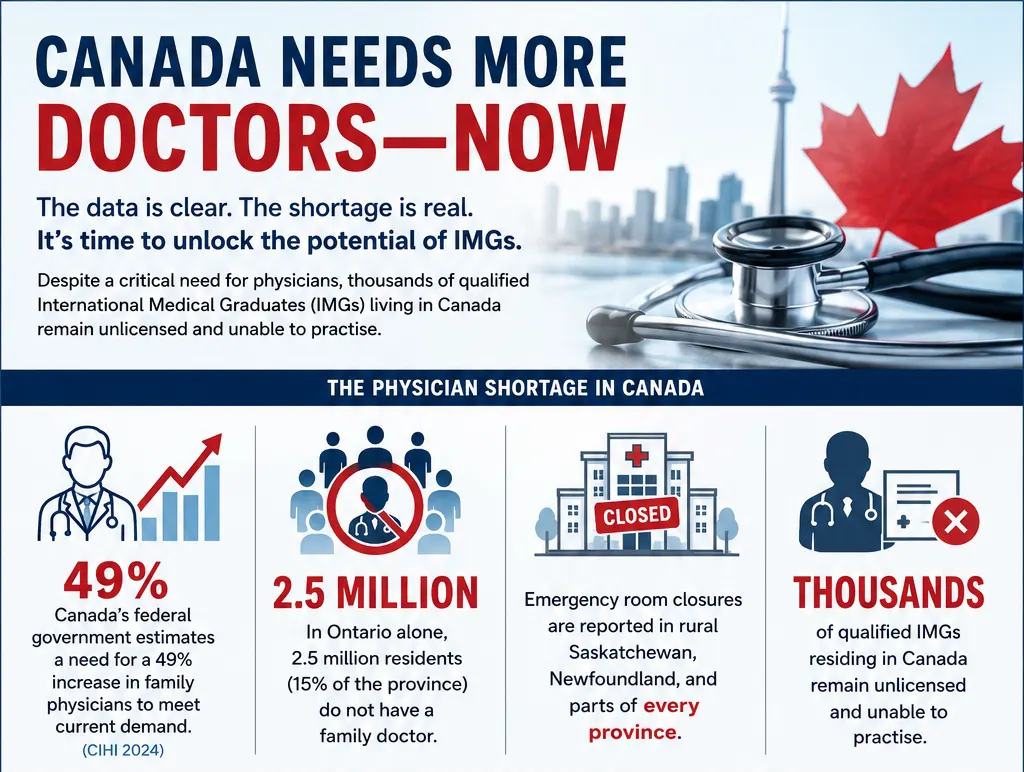
Canada's federal government estimates a need for a 49% increase in family physicians to meet current demand (CIHI 2024). In Ontario alone, 2.5 million residents (15% of the province) do not have a family doctor. Emergency room closures are reported in rural Saskatchewan, Newfoundland, and parts of every province. Yet thousands of qualified IMGs residing in Canada remain unlicensed.
IMGs currently represent approximately 27% of all practising physicians in Canada — yet hold under 10% of residency positions. In the 2025 CaRMS match, only 34.3% of IMGs secured family medicine residency positions, compared to 97.8% of Canadian medical graduates.
Pathway A: Residency via CaRMS
The Canadian Resident Matching Service (CaRMS) manages residency matching nationally. IMG-designated positions are limited: of 3,532 total residency positions available in Canada in 2023, only 370 were allocated to IMGs. Competition is very high (Ontario alone has an IMG applicant-to-position ratio exceeding 4:1).
Required exams before CaRMS application:
- MCCQE Part I — national qualifying exam (fee: $1,470 CAD). Source verification through physiciansapply.ca required first.
- NAC OSCE — national assessment collaboration OSCE for IMGs
Key 2026 Ontario note: Ontario introduced a controversial policy for the 2026 CaRMS cycle requiring IMGs to have attended Ontario high school for at least 2 years to access the province's IMG residency stream in the first iteration. As of early 2026, this policy was stayed by an Ontario Superior Court injunction and remains under legal challenge. Verify current status with CPSO directly.
Pathway B: Practice-Ready Assessment (PRA)
PRA is an alternative to full residency for experienced foreign-trained family physicians. It involves a supervised clinical assessment in a community practice setting, typically tied to return-of-service in an underserved area.
| Province | Program | Annual Volume (2024) | Key Features |
|---|---|---|---|
| British Columbia | PRA-BC | 96 assessments | Increased from 41 in 2023; family medicine focus |
| Alberta | PRA-Alberta | 92 assessments | One of the most active programs nationally |
| Saskatchewan | PRA-Saskatchewan | 45 assessments | Rural ROS commitment required |
| Nova Scotia | PRA-Nova Scotia | Variable | ROS to shortage communities |
| PEI | PEI-McMaster Hospitalist Fellowship | New | 1-year training for hospitalists; replaces standalone PRA |
Return of Service (ROS): PRA almost always includes a legal ROS agreement requiring practice in an underserved community for a defined period. This is a binding contract with financial penalties for non-compliance.
Canadian work experience requirement: PR status (Citizen or PR) is required for most PRA programs before participating.
Physician PR Pathway (2026 Update)
Beginning in 2026, IRCC formalized a dedicated Physicians with Canadian Work Experience Express Entry draw category. The first draw issued ITAs at a CRS cut-off of just 169 — by far the lowest in the system's history. This category targets physicians already practising in Canada under a temporary work authorization who want to transition to permanent residence.
For IMGs not yet in Canada, the broader Healthcare and Social Services category remains the primary Express Entry pathway.
Estimated physician earnings in Canada:
| Role | Average Annual (CAD) |
|---|---|
| Family physician | $240,000–$300,000 |
| Specialist | $320,000–$500,000+ |
| Rural / remote physician | Base + relocation, housing, and return-of-service bonuses |
Pathway for Internationally Educated Pharmacists
The Pharmacy Examining Board of Canada (PEBC) made its most significant change to the international pharmacist certification pathway in decades, effective May 13, 2025: a Streamlined Pathway that allows eligible international pharmacy graduates to skip the Evaluating Examination entirely.
Who qualifies for the Streamlined Pathway:
- Graduates from pharmacy programs accredited by ACPE (US accreditor) or CCAPP (Canadian accreditor), OR
- Pharmacists who held a full, unrestricted pharmacy license and practiced for at least 1 year in direct patient care within the past 3 years in an ACPE/CCAPP-accredited country or the United States
Standard pathway (for those who do not qualify for streamlined):
| Step | Description |
|---|---|
| 1 | Enroll in Pharmacists' Gateway Canada |
| 2 | Complete PEBC Document Evaluation |
| 3 | Pass PEBC Pharmacist Evaluating Examination (4.25 hours; computer-based) |
| 4 | Pass PEBC Qualifying Examination Part I (MCQ) |
| 5 | Pass PEBC Qualifying Examination Part II (OSCE) |
| 6 | Apply for provincial licensure (e.g., OCP in Ontario, ACP in Alberta, CPBC in BC) |
Streamlined pathway jumps from Step 2 directly to Step 4, removing the Evaluating Exam for eligible candidates.
Note: Quebec (OPQ) operates its own separate evaluation process and does not require Pharmacists' Gateway Canada enrollment.
Express Entry for Pharmacists
Pharmacists (NOC 31120) are included in the Healthcare and Social Services category. The November 2025 draw (CRS 462, 3,500 ITAs) and February 2026 draw (CRS 467, 4,000 ITAs) both explicitly included this NOC. With one year of qualifying experience, pharmacists are strongly positioned for category-based invitations.
Province-by-Province Healthcare Demand
Shortages are national but unevenly distributed. Target your destination strategically.
| Province | Demand Level | Key Facts |
|---|---|---|
| Ontario | Very High | 5.0% vacancy rate (2024); 2.5M residents without a family doctor; largest IEN infrastructure |
| British Columbia | Very High | PRA-BC increased to 96 assessments/year; Triple Track pathway for experienced nurses; active IEHP recruitment |
| Alberta | High | 92 PRA assessments/year; $30,000 IEN bursary; AAIP targets rural healthcare workers |
| Nova Scotia | High | Conditional nursing licenses allow work during NCLEX; ROS physician programs active |
| Manitoba | High | Strong rural physician demand; MPNP streams for healthcare workers |
| Saskatchewan | High | PRA-SK active; persistent rural shortage; SINP occupation priority lists include health roles |
| New Brunswick | Moderate–High | Atlantic Immigration Program healthcare pathways; growing IEN recruitment |
| PEI | Moderate | New PEI-McMaster Hospitalist Fellowship for IMGs |
| Newfoundland & Labrador | High | Severe rural shortages; ROS incentive programs active |
Critical stat from Statistics Canada (Dec 2025): The healthcare vacancy rate in remote regions (9.3%) is nearly double that of accessible urban regions (5.5%). Healthcare professionals willing to practice in rural or remote settings face significantly less competition, faster licensing in some provinces, and additional financial incentives.
PNP Additional Points For Healthcare Workers
A PNP nomination adds 600 CRS points — effectively guaranteeing an Express Entry ITA in the next all-program draw. Provinces with healthcare-specific or occupation-targeted PNP streams:
- Ontario OINP: In-Demand Skills stream and Employer Job Offer streams cover regulated health professions
- BC PNP Health Authority stream: Targets healthcare workers sponsored directly by a BC regional health authority
- Alberta AAIP: Active healthcare targeting in rural communities with Job Offer and Rural Renewal streams
- Manitoba MPNP: In-demand occupations stream includes many health NOCs
- Nova Scotia NSNP: Skilled Worker stream with healthcare occupation priority
Alternative Careers During Your Licensing Transition
Many IEHPs arrive in Canada and find themselves in a gap: authorized to work, but not yet licensed. These roles leverage healthcare training, build Canadian experience, and often count toward licensing requirements (e.g., CNO Evidence of Practice):
| Transition Role | Key Benefit |
|---|---|
| Personal Support Worker (PSW) | Builds Canadian healthcare experience for CRS and CNO Evidence of Practice |
| Medical Office Administrator | No licensing needed; maintains sector connection; builds Canadian references |
| Healthcare Aide / Home Support Worker | NOC 44101 — eligible for some Express Entry programs |
| Research Assistant (hospital or academic) | Builds Canadian network; may exempt from return-of-service obligations |
| Medical Laboratory Assistant | NOC 33101 — within the healthcare Express Entry category |
| Pharmacy Technical Assistant | NOC 33103 — within the healthcare Express Entry category |
Working in healthcare support roles while completing licensing also helps maintain the 3-year practice currency required by provincial nursing regulators and strengthens your Express Entry profile by accumulating Canadian work experience.
What's Changed in 2026: Key Updates at a Glance
| Change | Effective Date | Impact |
|---|---|---|
| Healthcare category minimum experience: 6 months → 1 year | Feb 18, 2026 | Slightly higher bar; reduces queue competition |
| Dedicated Physicians draw (CRS 169) | Feb 2026 | Major breakthrough for IMGs with Canadian work experience |
| New senior managers, researchers, military, and transport draw categories | Feb 2026 | Expanded category-based selection beyond healthcare |
| PEBC Streamlined Pathway (skip Evaluating Exam) | May 13, 2025 | Faster route to licensure for eligible pharmacists |
| CNO updated education and registration requirements | April 1, 2025 | Multiple approved credential assessment providers; updated Evidence of Practice enforcement |
| Federal Foreign Credential Recognition Program investment | March 2025 | $14.3M to reduce barriers for IEHPs nationally |
| IRCC public consultation on Express Entry reforms | Closes May 24, 2026 | Potential future changes to CRS scoring and selection criteria |
Summary
Three structural facts define the opportunity for IEHPs in 2026:
- The shortage is real and government-acknowledged. Canada needs 49% more family physicians, 28,000 more RNs, and 14,000 more LPNs. These are federal government figures, not estimates from advocacy groups.
- The immigration pathway is purpose-built. The healthcare category Express Entry draw has issued over 23,000 ITAs since June 2023. In 2025 alone, 13,500 invitations went to healthcare professionals at CRS scores 40–50 points below what all-program draws required. The physicians-specific draw lowered the CRS floor to 169 for experienced doctors.
- The licensing infrastructure is improving. PEBC's May 2025 streamlined pathway, CNO's April 2025 registration updates, NNAS's expedited 5-day service, and $14.3M in federal credential recognition funding all represent genuine, measurable reductions in the time and cost of becoming licensed.
The path is real. It takes preparation, patience, and strategic timing — but Canada has built it specifically for you.
Key Government and Regulatory Sources
Medical Council of Canada (MCC)