Recommended Blog Posts
- Move To Canada As An Architect (NOC -21200) In 2026: PR Pathways, Salary, Licensing & Demand
- Electrician Work Permit to PR in Canada: What Changes After 1 Year of Experience?
- Why Canada Needs Experienced General Surgeons (NOC - 31101) In 2026: Demand, Salaries, And Fast-Track PR Options
- NOC Code List: Why NOC Codes Matter for Immigration (2026 Update)
- Urologist Jobs (NOC 31101.04) in Canada: Provinces With Shortages, Expected Earnings, and Hiring Trends -2026 Guide
Canada’s Growing Demand For OB/GYN Doctors (NOC - 31101): Salary, Shortages, And PR Options In 2026
Publish On: March 06, 2026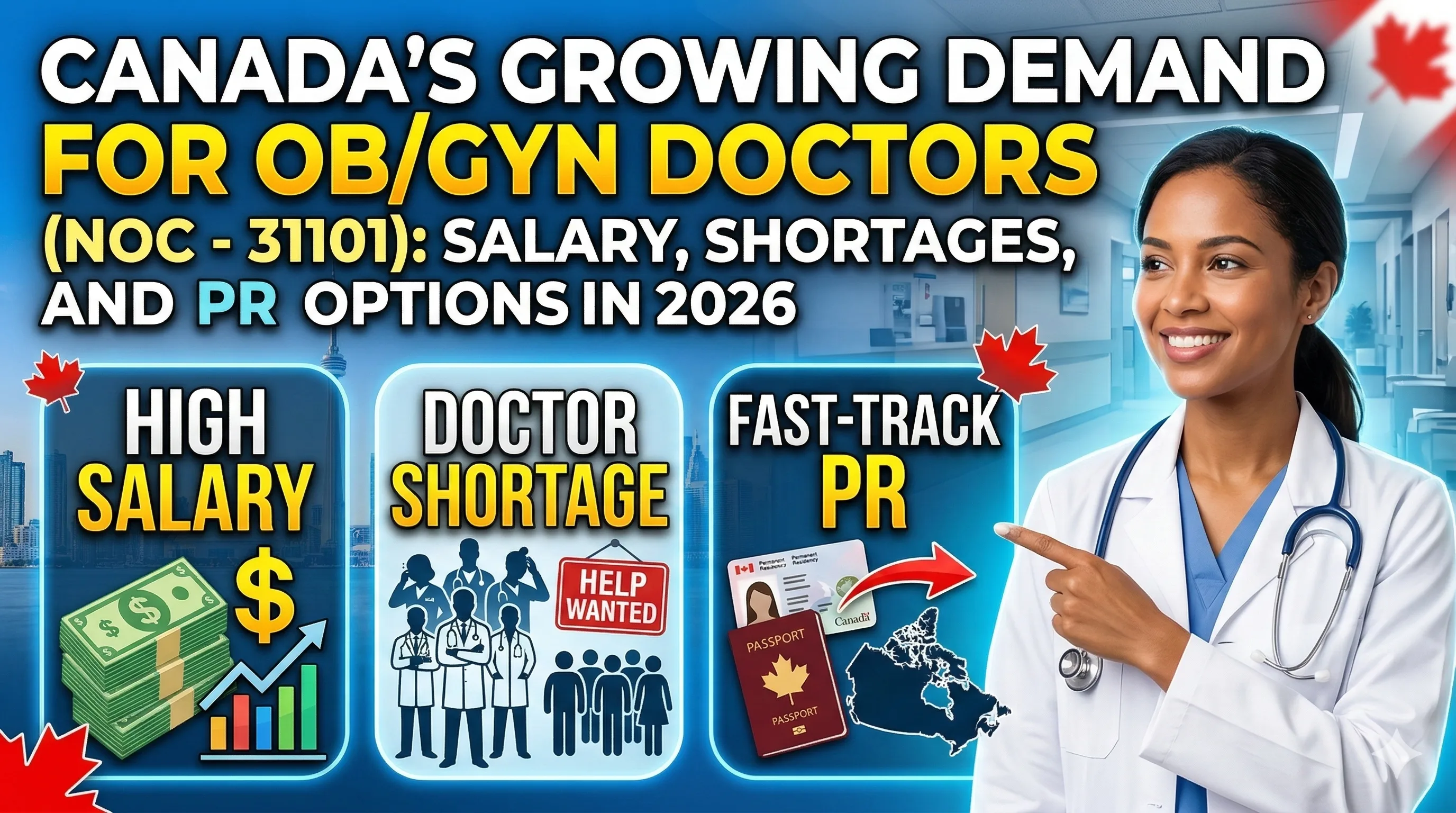
Canada’s healthcare system is facing a growing shortage of obstetricians and gynecologists (OB/GYNs). Rising birth-care demand, physician retirements, and expanding women’s health services have created a critical gap in maternity and reproductive care across many provinces.
At the same time, Canada’s immigration system has shifted toward labour-market targeted immigration, where healthcare professionals—especially physicians and surgeons—are prioritized.
For experienced OB/GYN specialists worldwide, including physicians practicing in the United States, Canada now offers a combination of:
- Strong demand
- Competitive physician compensation
- Dedicated healthcare immigration pathways
- Long-term professional stability
Canada’s OB/GYN Shortage Is Becoming A National Issue
Women’s health services are expanding across Canada, but physician supply has not kept pace. Hospitals increasingly struggle to recruit obstetricians and gynecologists, particularly in mid-size cities and rural communities.
Several workforce indicators highlight the shortage.
| Healthcare Workforce Indicator | Latest Estimates |
|---|---|
| OB/GYN specialists in Canada | ~1,800 |
| Canadians without a family doctor | ~6.5 million |
| Physicians expected to retire in 10 years | ~25% |
| Regions reporting OB/GYN shortages | Most rural provinces |
Maternity units in several regions have reduced services or temporarily closed due to physician shortages. This shortage is one reason Canada has begun actively recruiting internationally trained OB/GYNs.
Why OB/GYN Specialists Are Critical To Canada’s Healthcare System
OB/GYNs provide a wide range of essential services that affect both maternal health and long-term women’s healthcare. Their role extends far beyond childbirth.
Common responsibilities include:
- Pregnancy and delivery care
- High-risk obstetrics
- Gynecological surgery
- Reproductive health treatment
- Cancer screening and surgical care
Canada’s healthcare planners consider OB/GYNs part of the broader Healthcare and Social Services Occupations priority category, which receives targeted attention in immigration policies.
NOC Code For OB/GYNs In Canada
Immigration programs categorize physicians under Canada’s National Occupational Classification system.
| Occupation | NOC Code | TEER Level |
|---|---|---|
| Specialist Physicians (includes OB/GYN) | 31101 | TEER 1 |
This classification includes physicians who:
- Diagnose reproductive health conditions
- Perform obstetric and gynecologic surgeries
- Manage pregnancy and childbirth care
- Provide preventative and reproductive healthcare
The NOC classification determines eligibility for Express Entry programs, provincial nomination streams, and healthcare category draws.
IRCC Healthcare Immigration Draws Are Benefiting Physicians
Canada introduced category-based Express Entry draws to address labour shortages in key sectors. Healthcare is one of the most prominent categories. Recent healthcare draws have invited professionals from occupations such as:
| Healthcare Priority Occupations |
|---|
| Physicians and surgeons |
| Registered nurses |
| Dentists |
| Physiotherapists |
| Pharmacists |
| Medical technologists |
Healthcare draws allow physicians to compete within a smaller candidate pool, increasing the probability of receiving an Invitation to Apply (ITA).
| Draw Type | Typical CRS Score Range |
|---|---|
| Healthcare category draw | 460-480 |
| General Express Entry draw | 500+ |
| PNP draw | 700+ (with nomination points) |
This strategy aligns immigration with healthcare workforce needs.
Provincial Nominee Programs Recruiting OB/GYNs
Provinces manage their own healthcare systems and frequently recruit physicians through Provincial Nominee Programs (PNPs).
Many provinces run dedicated physician recruitment streams.
| Province | Immigration Program |
|---|---|
| British Columbia | BC PNP Health Authority Stream |
| Ontario | OINP Employer Job Offer |
| Nova Scotia | Physician Stream |
| Saskatchewan | Health Talent Pathway |
| Manitoba | Skilled Worker Overseas |
Hospitals and regional health authorities often sponsor OB/GYNs directly through these programs. Once nominated, candidates receive 600 CRS points, which almost guarantees permanent residence through Express Entry.
Surgical And Maternity Care Backlogs Are Increasing
Canada’s healthcare system continues to deal with procedure backlogs and maternity care shortages.
During the pandemic, many elective gynecological surgeries were postponed.
This created a backlog of procedures including:
- Hysterectomies
- Endometriosis surgeries
- Fertility procedures
- Pelvic reconstructive surgeries
Hospitals are now expanding surgical capacity and recruiting more specialists to clear these delays. This increased surgical demand is one reason OB/GYN recruitment has accelerated in recent years.
Competitive Salary For OB/GYN Specialists
Physicians in Canada are among the highest-paid professionals in the country. OB/GYN specialists typically earn income through provincial billing systems and hospital payments.
| Medical Specialty | Average Annual Income (CAD) |
|---|---|
| OB/GYN | $450,000 – $550,000 |
| General Surgery | $570,000 |
| Orthopedic Surgery | $520,000+ |
| Family Medicine | $280,000 |
Income varies depending on:
- Province
- Surgical volume
- Hospital contracts
- Subspecialty practice
Many provinces also offer rural recruitment incentives, relocation packages, and signing bonuses for OB/GYNs.
Work Permit Pathways For International Physicians
Not all OB/GYNs immigrate directly through PR programs. Some begin working in Canada through physician work permits. Common entry pathways include:
| Entry Route | Description |
|---|---|
| Hospital-sponsored work permit | Physicians recruited by health authorities |
| Fellowship programs | Subspecialty training in Canada |
| Residency programs | Canadian medical training |
| Provincial recruitment initiatives | Rural physician programs |
After gaining experience in Canada, many physicians qualify under Express Entry pathways for Physicians With Canadian Work Experience. This significantly improves their chances of obtaining permanent residence.
Licensing Requirements For OB/GYNs
Before practicing independently, physicians must obtain professional certification.
The typical pathway includes:
- Credential verification
- Certification through the Royal College of Physicians and Surgeons of Canada
- Provincial medical licensing
Many provinces have created bridging programs for internationally trained doctors to accelerate this process.
Why Canada Is Attracting U.S. OB/GYN Specialists
Canada has also seen increasing interest from American physicians.
Several factors contribute to this trend.
| Factor | Canada | United States |
|---|---|---|
| Malpractice insurance costs | Lower | Higher |
| Administrative workload | Moderate | High |
| Healthcare system | Universal | Insurance-based |
| Physician immigration pathways | Expanding | N/A |
Canadian hospitals increasingly recruit U.S.-trained OB/GYN specialists because their training aligns closely with Canadian certification standards.
Long-Term Outlook For OB/GYN Careers In Canada
Demand for OB/GYN specialists is expected to remain strong for decades.
Several demographic trends support this outlook.
| Long-Term Trend | Impact |
|---|---|
| Aging population | Increased gynecological care |
| Expanding women’s health programs | Higher demand |
| Physician retirements | Workforce shortages |
| Population growth | Increased maternity care |
These trends ensure OB/GYN specialists remain part of Canada’s priority healthcare occupations for immigration and recruitment.
Final Thoughts
Canada’s healthcare workforce strategy increasingly relies on immigration to fill physician shortages. OB/GYN specialists sit at the intersection of several national priorities: maternity care access, women’s health services, and surgical capacity.
With Healthcare and Social Services Occupations draws, physician-focused PNP streams, and pathways for physicians with Canadian work experience, Canada has created multiple routes for experienced OB/GYNs to obtain permanent residence.
For internationally trained specialists seeking career stability, competitive earnings, and a clear immigration pathway, Canada is becoming one of the most promising destinations in global healthcare.