Recommended Blog Posts
- Move To Canada As An Architect (NOC -21200) In 2026: PR Pathways, Salary, Licensing & Demand
- Why Canada Is A Top Destination For Orthopedic Surgeons: High Demand, Strong Pay, And Long-Term Stability
- NOC Code List: Why NOC Codes Matter for Immigration (2026 Update)
- Urologist Jobs (NOC 31101.04) in Canada: Provinces With Shortages, Expected Earnings, and Hiring Trends -2026 Guide
- How to Get Canada PR as an Electrician (NOC -72200) in 2026: The Ultimate Guide
Is Canada Still Looking To Issue ITAs To Nurses (NOC 31301) ? Approx Salary In Each Canadian Provinces
Publish On: January 05, 2026
Canada faces a critical healthcare workforce shortage that presents unprecedented opportunities for qualified nurses worldwide. Between 2022 and 2024, nursing job postings increased by 36%, with demand continuing to surge across all provinces for 2026. The Canadian government has responded by streamlining immigration pathways specifically for healthcare professionals, making 2025 one of the best times to pursue nursing immigration to Canada.
Whether you're a registered nurse (RN), licensed practical nurse (LPN), or nursing graduate exploring pathways to permanent residence, this comprehensive guide covers everything you need to know about immigrating to Canada as a nurse.
Understanding Canada's Nursing Shortage: The Opportunity for International Nurses
Current Demand Statistics
Canada's healthcare system faces significant staffing challenges:
- 27,800 job openings projected for Licensed Practical Nurses between 2022-2031
- Only 26,300 new job seekers expected, creating a shortfall of 1,500 LPNs
- 26% of current nurses are aged 50 and over, with median retirement age of 63
- High risk of labour shortage nationally between 2024-2033
Why the Shortage Exists
- Aging Population: Increasing demand for healthcare services as Canada's population ages
- Retirements: Significant portion of nursing workforce approaching retirement
- Post-Pandemic Impact: COVID-19 pandemic accelerated workforce challenges
- Geographic Distribution: Rural and remote areas face particularly acute shortages
Types of Nurses in Canada: Understanding Your Pathway
| Nurse Type | NOC Code 2021 | Education Required | Licensing Exam | Average Annual Salary |
|---|---|---|---|---|
| Registered Nurse (RN) | 31301 | Bachelor of Science in Nursing (4 years) | NCLEX-RN | CAD $70,000 - $110,000 |
| Registered Psychiatric Nurse (RPN) | 31301 | 2.5-4 year psychiatric nursing program | NCLEX-RN | CAD $70,000 - $110,000 |
| Licensed Practical Nurse (LPN) | 32101 | 2-year diploma program | CPNRE or REx-PN | CAD $44,100 - $66,105 |
| Nurse Practitioner (NP) | Advanced RN | Master's degree in nursing | NP Certification Exam | CAD $114,400+ |
Hourly Wage Ranges by Province (Approx)
According to Government of Canada Job Bank data (updated November 2025):
| Province/Territory | Median Hourly Wage (RN) |
|---|---|
| Nunavut | $64.69 |
| Northwest Territories | $56.00 |
| Yukon | $48.30 |
| Alberta | $42.00 - $51.08 |
| Ontario | $40.00 |
| British Columbia | $40.00 - $45.00 |
| Quebec | $38.50 |
| National Average | $42.00 |
Federal Immigration Pathways for Nurses
1. Express Entry System
Express Entry remains the primary federal pathway for skilled worker immigration, with special provisions through express entry draws for healthcare workers.
Federal Skilled Worker Program (FSWP)
Eligibility Requirements:
- Minimum 1 year continuous work experience in nursing within past 10 years
- Work experience can be gained abroad or in Canada
- Language proficiency: CLB 7 minimum (equivalent to IELTS 6.5 overall)
- Educational Credential Assessment (ECA) for foreign degrees
- Minimum 67 points out of 100 on selection grid
Points Breakdown:
- Education: Up to 25 points
- Language Skills: Up to 28 points (first official language) + 4 points (second)
- Work Experience: Up to 15 points
- Age: Up to 12 points (maximum at ages 18-35)
- Arranged Employment: Up to 10 points
- Adaptability: Up to 10 points
Occupation-Specific Express Entry Draws for Nurses
Since 2024, Immigration, Refugees and Citizenship Canada (IRCC) conducts targeted draws specifically for healthcare workers including nurses. These draws offer significant advantages:
- Lower CRS score requirements: Healthcare draws often have cutoffs 50-100 points lower than general draws
- No job offer required: Nurses with at least 6 months continuous experience qualify
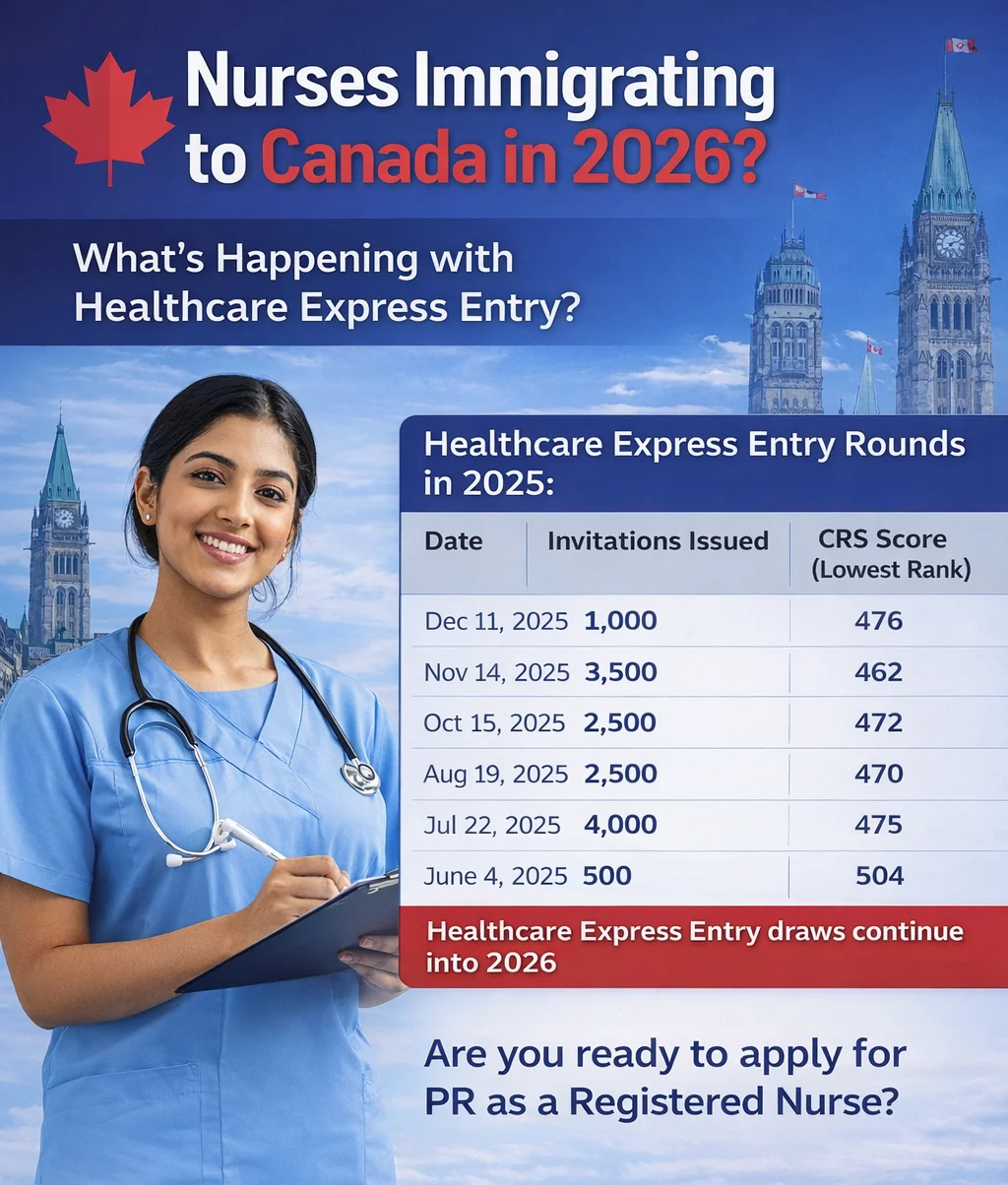
- Recent draw data: CRS scores for healthcare categories ranged from 422-510 in 2024-2025
Recent Express Entry Healthcare Draws
- Number of invitations: 1,000
- Category: Healthcare and Social Services
- This demonstrates continued prioritization of healthcare professionals
2. Provincial Nominee Programs (PNPs)
Each Canadian province operates its own immigration programs targeting specific labour market needs. Many provinces have dedicated streams for nurses.
Ontario Immigrant Nominee Program (OINP)
Human Capital Priorities Stream:
- Must have active Express Entry profile
- Ontario issues Notifications of Interest (NOI) to candidates in Express Entry pool
- Nurses frequently targeted in targeted draws
- Provincial nomination adds 600 CRS points to Express Entry profile
Recent Activity (December 2025):
- Ontario latest draw issued 2,300+ targeted invitations across multiple regions
- Healthcare occupations continue to be prioritized
British Columbia Provincial Nominee Program (BC PNP)
Healthcare Professional Stream:
- Fast-track option for U.S.-trained nurses launched May 2025
- Requires active U.S. nursing license in good standing
- Nursing education from accredited U.S. school
- Expedited registration and immigration process
Skills Immigration Stream:
- Job offer from BC employer required
- Employer must be registered with BC PNP
- Lower Express Entry scores accepted through Express Entry BC pathway
Nova Scotia Nominee Program (NSNP)
Labour Market Priorities Stream:
- Only open to candidates with Express Entry profile
- Invitations issued directly by province to qualified nurses
- Multiple draws conducted annually targeting nurses
- Must have experience in target occupation (NOC 31301 or 32101)
Saskatchewan Immigrant Nominee Program (SINP)
International Healthcare Workers EOI System:
- Expression of Interest (EOI) system for healthcare workers
- Includes registered nurses and licensed practical nurses
- Regular draws from EOI pool
- Job offer may be required depending on stream
Manitoba Provincial Nominee Program (MPNP)
Skilled Workers Stream:
- Nurses listed as Rural In-Demand Occupations
- Multiple pathways including Skilled Workers Overseas and Skilled Workers in Manitoba
- Connection to Manitoba required (employment, education, or family)
Recent Draw (December 2025):
- Manitoba issued 862 invitations
- Healthcare occupations specifically targeted
New Brunswick Provincial Nominee Program (NBPNP)
Critical Worker Pilot:
- Registered nurses, LPNs, and personal support workers in high demand
- Job offer from New Brunswick employer required
- Pathways for both temporary residents and foreign workers
Quebec Immigration
Quebec operates its own immigration system separate from federal programs.
Quebec Skilled Worker Program (QSWP):
- Application through Arrima portal
- Points-based selection system
- Regular draws targeting nurses
- French language proficiency often prioritized
- Must obtain Quebec Selection Certificate (CSQ) before federal PR application
3. Atlantic Immigration Program (AIP)
For nurses interested in Canada's Atlantic provinces (Nova Scotia, New Brunswick, Prince Edward Island, Newfoundland and Labrador):
Requirements:
- Job offer from designated employer in Atlantic Canada
- Work experience requirement varies by program stream
- Lower language requirements than other programs
- Settlement plan and support from settlement service provider
Salary Expectations and Benefits
Average Salaries for Nurses in Canada (2025)
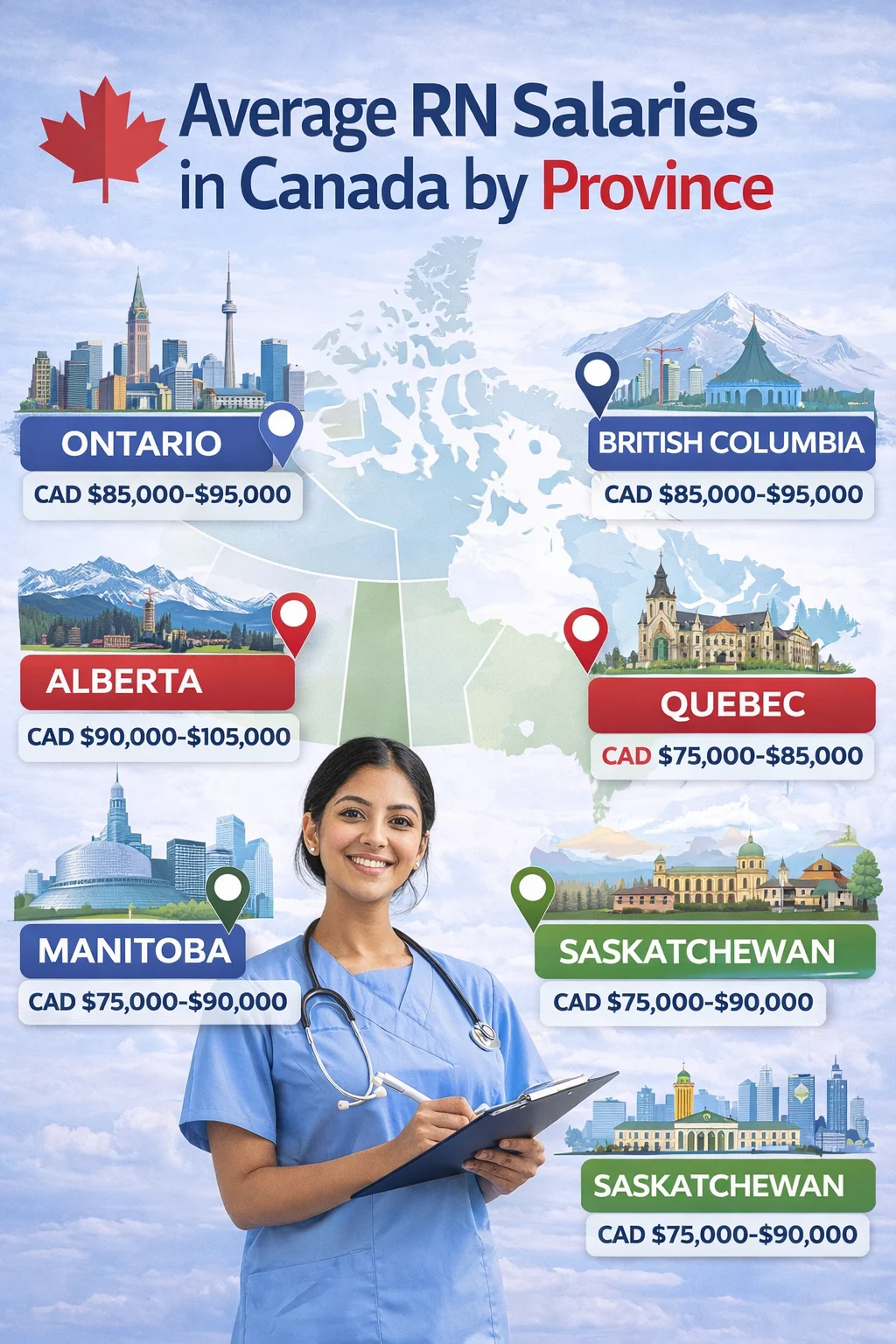
Nursing remains one of Canada's strongest PR-friendly occupations in 2025–2026. Even entry-level nurses earn CAD 70,000–82,500, while experienced and specialized nurses can cross CAD 120,000+ annually, placing them well above Canada's median income threshold.
From an RCIC perspective, Registered Nurses and Nurse Practitioners stand out—not only for high salaries (CAD 87,000–114,000+) but also because they consistently qualify under Healthcare category-based Express Entry draws and multiple Provincial Nominee Programs (PNPs). Higher earnings also translate into stronger CRS scores, better settlement outcomes, and long-term career stability.
Salaries for Nurses By Experience Level
| Experience Level | Average Annual Salary |
|---|---|
| Entry-Level (0-1 years) | CAD $70,000 - $82,500 |
| Early Career (1-4 years) | CAD $72,000 - $85,000 |
| Mid-Career (5-9 years) | CAD $80,000 - $95,000 |
| Experienced (10-20 years) | CAD $95,000 - $120,000 |
| Senior/Specialized | CAD $120,000+ |
Salaries for Nurses By Nurse Type
| Position | Average Annual Salary | Hourly Rate |
|---|---|---|
| Licensed Practical Nurse | CAD $62,712 | CAD $28.70 |
| Registered Nurse | CAD $87,360 | CAD $42.00 |
| Nurse Practitioner | CAD $114,400 | CAD $55.00 |
| Nurse Educator | CAD $87,610 | CAD $42.00 |
| Specialized RN (ICU, OR) | CAD $90,000 - $110,000 | CAD $43.00 - $53.00 |
Factors Affecting Salary For International Nurses In Canada
For international nurses in Canada, salary is influenced by where you work, what you specialize in, and how flexible you are. Nurses in rural or northern regions often earn more due to incentives and bonuses.
- Location (Urban vs Rural)
Rural and northern areas often pay higher salaries and offer faster PR options. - Work Setting
Hospitals and high-demand facilities usually pay more than clinics or basic care centers. - Shift Differentials
Night, weekend, and holiday shifts come with extra pay. - Specialization
ICU, Emergency, OR, and Critical Care nurses earn significantly higher wages. - Education Level
Higher qualifications = better pay bands and stronger PR profiles. - Overtime
Extra hours can substantially increase annual income. - Remote & Northern Bonuses
Some provinces offer bonuses, incentives, and quicker nominations.
Best Provinces for International Nurses
There is no single best province for all international nurses—the right choice depends on CRS score, language ability, income goals, and flexibility.
- Ontario & British Columbia offer the most jobs and world-class healthcare but are highly competitive with high living costs.
- Alberta stands out for highest nursing salaries, lower taxes, and strong demand, making it ideal for income-focused nurses.
- Quebec is a strong option for French-speaking nurses, with targeted Arrima draws and a lower cost of living.
- Atlantic provinces, Manitoba, and Saskatchewan are the most PR-friendly, offering lower CRS requirements, strong healthcare demand, and faster provincial pathways.
Nurses willing to be location-flexible—especially in smaller or rural provinces—have the fastest and most realistic path to Canadian PR.
Ontario
| Advantages | Challenges |
|---|---|
|
|
Alberta
| Advantages | Challenges |
|---|---|
|
|
British Columbia
| Advantages | Challenges |
|---|---|
|
|
Quebec
| Advantages | Challenges |
|---|---|
|
|
Manitoba
| Advantages | Challenges |
|---|---|
|
|
Saskatchewan
| Advantages | Challenges |
|---|---|
|
|
Conclusion: Your Nursing Career in Canada Awaits
Canada's healthcare system is actively recruiting international nurses, creating a strong opportunity for qualified professionals worldwide. With a 36% rise in nursing job postings, occupation-specific Express Entry draws, and targeted Provincial Nominee Programs (PNPs), nurses now have clearer and faster pathways to permanent residence and citizenship.
While the process requires careful planning—especially credential assessment through NNAS, licensing, and NCLEX preparation—Canada offers competitive salaries, long-term career stability, and an excellent quality of life. Early preparation, smart province selection, financial readiness, and use of support programs like PASS significantly improve success rates.
Note: Immigration rules and requirements change regularly. Always verify current information on official government websites including canada.ca/immigration and provincial regulatory body websites. Consider consulting with a licensed immigration consultant or lawyer for personalized guidance.
Official Resources:
- Immigration, Refugees and Citizenship Canada (IRCC): www.canada.ca/immigration
- National Nursing Assessment Service (NNAS): www.nnas.ca
- Pre-Arrival Supports and Services (PASS): www.pass4nurses.org
- Provincial Regulatory Bodies: Links provided in Step 1 of process section