Recommended Blog Posts
- The Ultimate 2026 Guide: Canada PR for Software Developers (NOC 21232 / NOC 21231)
- The Ultimate 2026 Guide: Canada Immigration From the UAE
- Which Canadian Provinces Offer the Best Salary Packages for Nurses in 2026?
- Nursing Officer Salary in Canada in 2026: Is Moving to Canada Still Worth It for International Nurses?
- Can Internationally Educated Nurses Really Build a Successful Career in Canada?
Canada PR vs Temporary Visa: 15 Powerful Benefits That Make PR the Better Choice in 2026
Publish On: April 08, 2026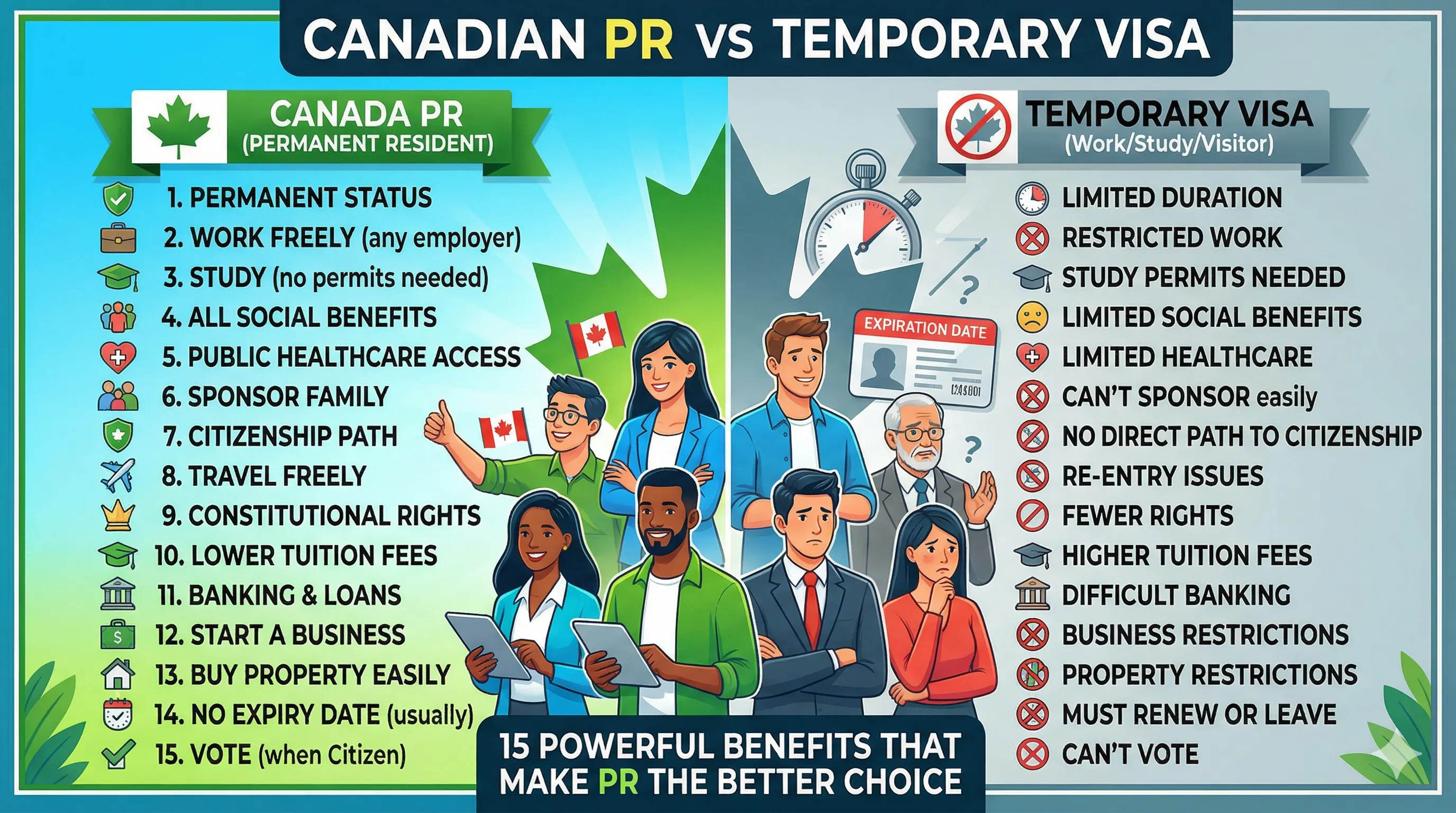
Canada’s immigration system is designed in two layers—temporary residence and permanent residence. While temporary visas can help foreign nationals enter Canada for study, work, or travel, they come with time limits and conditions. Permanent residency offers a more stable future with broader rights, long-term flexibility, and a clearer path toward settlement.
Understanding the difference between Canada PR and temporary status is especially important in 2026, as more immigrants are looking beyond short-term entry and focusing on long-term security, family benefits, and career freedom in Canada.
What Is Canada PR And Temporary Visa?
Canada Permanent Residency (PR) Explained
Canada permanent residency allows foreign nationals to live in Canada on a long-term basis with many of the same rights enjoyed by citizens. Permanent residents can work, study, and live in any province or territory, access public services, and build a stable future in Canada.
PR status is not the same as citizenship, but it is one of the most important legal statuses for immigrants who want to settle permanently. It also creates a pathway toward Canadian citizenship once eligibility conditions are met.
Temporary Visa Explained
A temporary visa or temporary resident status is granted for a limited purpose and duration. This usually includes work permits, study permits, and visitor visas. The person is allowed to remain in Canada only as long as their status stays valid and they continue to meet the conditions attached to that permit.
Temporary status can be useful as an entry route into Canada, but it does not offer the same level of freedom, stability, or long-term benefits as permanent residency.
Canada PR vs Temporary Visa: Key Differences
| Feature | Canada PR | Temporary Visa |
|---|---|---|
| Duration | Long-term status with renewal of PR card | Time-limited and expiry-based |
| Work Rights | Can work for almost any employer in Canada | May be employer-specific or restricted |
| Mobility | Can live in any province or territory | May be tied to study, work, or visitor conditions |
| Healthcare Access | Broad access to provincial healthcare systems | Can be limited, delayed, or dependent on permit type |
| Citizenship Pathway | Yes | No direct pathway through temporary status alone |
| Family Sponsorship | Yes, subject to program requirements | Very limited |
| Long-Term Security | High | Low to moderate |
15 Benefits Of Canada PR Compared To Temporary Visa
1. Freedom To Live, Work, And Study Anywhere In Canada
One of the strongest advantages of permanent residency is flexibility. PR holders can generally live in any province, switch employers, or continue their studies without being restricted by the original purpose of their entry into Canada.
Temporary residents often face restrictions. A worker may be tied to one employer, while a student may be connected to one designated learning institution. PR removes many of these barriers and gives immigrants greater control over their future.
2. Greater Long-Term Stability
Temporary permits expire. That means people on temporary status often need to apply for extensions, maintain eligibility, and manage uncertainty about whether they can continue staying in Canada.
Permanent residency offers a more secure foundation. Although PR cards must be renewed, PR status itself is designed for people who want to settle in Canada long term and build their lives there.
3. Better Access To Public Healthcare
Permanent residents are generally eligible for provincial or territorial health coverage, depending on local rules. This can reduce medical costs significantly and give families a stronger sense of security.
Temporary residents may have partial coverage, delayed eligibility, or no public coverage at all, depending on their province and type of permit. In many cases, they must rely on private insurance for at least part of their stay.
4. A Clear Pathway To Canadian Citizenship
PR is one of the most important stepping stones toward Canadian citizenship. Once a permanent resident meets the residency and legal requirements, they may apply for citizenship and eventually become eligible for a Canadian passport.
Temporary status does not provide that direct legal route on its own. For most immigrants, long-term settlement goals begin with becoming a permanent resident.
5. Ability To Sponsor Eligible Family Members
Permanent residents can sponsor certain family members under Canada’s family sponsorship programs, subject to eligibility rules. This can include spouses, dependent children, and in some cases parents or grandparents through specific streams.
Temporary visa holders do not usually have the same sponsorship rights. That makes PR especially valuable for people who want to reunite their family in Canada on a permanent basis.
6. More Job Flexibility And Career Growth
PR holders are in a stronger position when it comes to changing jobs, negotiating better roles, or relocating to other provinces for career growth. They do not need to depend on one employer to maintain their legal right to work in many situations.
Temporary foreign workers, especially those on closed work permits, can face major disruption if their employment ends. PR reduces that risk and supports long-term professional development.
7. Access To More Social Benefits
Permanent residents may qualify for a range of public programs and benefits, depending on federal and provincial eligibility conditions. These may include child-related benefits, employment-related support, and other public services.
Temporary residents often have limited access to these systems. Even when they contribute through taxes and work, their eligibility may remain restricted because of their temporary status.
8. Stronger Legal Protection In Daily Life
Permanent residents live in Canada with a stronger sense of continuity and legal security. They are protected under Canadian law and can participate more fully in society, the labour market, and community life.
While temporary residents are also protected by Canadian law, their day-to-day vulnerability can be higher because their status is time-bound and often tied to specific conditions.
9. Better Education Advantages For Children
Families with PR status often find it easier to plan their children’s education in Canada. Children can usually access public elementary and secondary schooling, and long-term settlement makes educational planning much more predictable.
At the post-secondary level, permanent residents may also benefit from domestic tuition rates instead of international student fees, depending on the institution and province. This can create major financial savings over time.
10. Less Dependence On Employer Sponsorship
Many temporary workers remain dependent on employer support, LMIA-based arrangements, or permit renewals. This can make their immigration journey more fragile and place their status at risk if their job situation changes.
PR gives immigrants more independence. They are not usually required to maintain one employer relationship simply to preserve their right to stay and work in Canada.
11. Easier Re-Entry And Travel Stability
Permanent residents can travel outside Canada and return using a valid PR card or permanent resident travel document, where applicable. This creates more stability for people who need to travel for family, business, or personal reasons.
Temporary residents may need new visas, updated documentation, or re-entry approvals depending on their nationality and travel circumstances. That makes international mobility more uncertain.
12. Access To Settlement And Integration Services
Permanent residents may be eligible for federally and provincially funded settlement services that help them integrate into Canadian life. These services can include language support, employment preparation, orientation, and community assistance.
Temporary residents often have fewer publicly funded support options, which can make settlement harder even when they are already contributing to Canada’s labour force or education system.
13. Better Position In The Job Market
Many employers prefer candidates who already hold PR because the hiring process is simpler and there is no need to address work permit limitations or future sponsorship questions. This can improve job prospects across many industries.
For the candidate, PR status also means greater confidence in pursuing long-term roles, leadership tracks, and province-to-province opportunities without immigration restrictions getting in the way.
14. Stronger Financial Stability Over Time
The financial difference between PR and temporary status can become significant over the long run. Public healthcare access, lower education costs, broader benefit eligibility, and fewer immigration-related disruptions can all reduce long-term expenses.
Temporary status often comes with renewal costs, compliance obligations, status anxiety, and practical limitations that affect financial planning.
15. Better Alignment With Long-Term Immigration Goals
For most immigrants who want to build a life in Canada, PR is the real destination. It aligns with long-term goals such as citizenship, home ownership, family reunification, educational planning, and stable employment.
Temporary visas can open the door, but permanent residency is what allows many newcomers to fully participate in Canadian society without living under expiry-based uncertainty.
Who Should Prioritize Canada PR?
PR should be a priority for immigrants who want to establish a long-term future in Canada rather than simply remain in the country for a limited period. This includes skilled workers, international graduates, temporary foreign workers, and families who want a more stable foundation.
It is especially important for people whose goals include career mobility, family sponsorship, lower education costs, and eventual citizenship.
Canada PR offers major long-term advantages over temporary visas, including broader work freedom, greater mobility, stronger stability, access to healthcare and public services, family sponsorship options, and a pathway to citizenship. Temporary visas remain important for entry into Canada, but PR is the status that gives immigrants the ability to build a secure and lasting future.
Conclusion
Temporary visas can help people enter Canada, gain education, and build work experience. But when the goal is a stable life, long-term security, and a stronger future for the whole family, permanent residency offers far more value.
From job flexibility and social access to citizenship potential and settlement security, Canada PR stands well above temporary status in nearly every major area that matters. For many newcomers, the most practical strategy is not choosing between temporary residence and PR, but using temporary status as a stepping stone toward permanent residency.